Yemen
Capital: Sana'a. Yemen is one of the 48 countries in the Asia quiz.
Quick answers: What is the capital of Yemen? · Which countries border Yemen?
Facts about Yemen
- CapitalSana'a
- Population41.8 million
- Area527,968 km²
- RegionsAsia, Middle East
- LanguageArabic
- CurrencyYemeni rial (YER)
Yemen is the 16th most populous of the 48 countries in Asia and the 12th largest by area. Worldwide it ranks 37th by population and 49th by area.
Where is Yemen?
Yemen occupies the south-western corner of the Arabian Peninsula. Saudi Arabia lies to the north and Oman to the east. The Red Sea is on its western coast and the Gulf of Aden on its southern coast, with the narrow Bab-el-Mandeb strait separating it from Djibouti and Eritrea in Africa. The island of Socotra, far out in the Arabian Sea, is Yemeni. The capital, Sanaa, is in the mountainous west; the port of Aden is on the south coast.
On a world map, find the Arabian Peninsula – the big rectangular block between Africa and Iran. Yemen is the bottom-left corner of that block, where the Red Sea meets the Indian Ocean.
How to find Yemen on the map
- Start from Saudi Arabia. Yemen is the country directly below Saudi Arabia's south-western border.
- Look for the Bab-el-Mandeb. The narrow gap where the Red Sea opens into the Gulf of Aden is Yemen's south-west tip; Djibouti is on the other side.
- Find the Horn of Africa. Yemen is the land just across the water from Somalia and Djibouti.
- Don't confuse it with Oman. Oman is the eastern corner of the peninsula, facing the Arabian Sea; Yemen is the south-western one, with Red Sea coast.
Flag
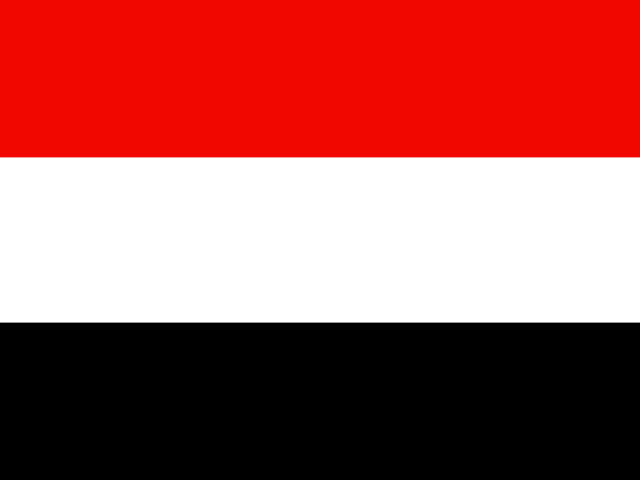
Yemen's flag is a horizontal tricolour of red, white and black, with no emblem. These are the Pan-Arab colours, and the flag was adopted in 1990 when North and South Yemen united.
In the Flags quiz, it is the simplest of a confusing family. Egypt uses the same stripes with a golden eagle in the centre, Syria adds two green stars and Iraq adds green Arabic script. A plain red-white-black with nothing in the white band is Yemen.
A short history of Yemen
Ancient Greeks and Romans called this corner of Arabia Arabia Felix – "happy" or "fortunate" Arabia – because its mountains caught monsoon rains and its kingdoms grew rich on frankincense and myrrh. The best known was Saba, often linked to the biblical Queen of Sheba. Its people built the great Marib Dam, a feat of engineering that watered fields for over a thousand years until its final collapse around the 500s AD. Later the Himyarite kingdom ruled much of the south-west.
Islam spread here early, in the 600s. From the 890s, the Zaydi imams, a branch of Shia Islam, ruled in the northern highlands, and Zaydi imams held power there on and off for about a thousand years. The Ottoman Empire controlled parts of Yemen in the 1500s and 1600s and again from the 1870s, while earlier, from the 1200s to the 1400s, the Rasulid dynasty had ruled the south-west from Taiz and Zabid.
The modern division began in 1839, when Britain seized Aden as a coaling station on the sea route to India. The British gradually took control of the south, while the north stayed under the Ottomans and then, after 1918, an independent Zaydi kingdom. In 1962 army officers overthrew the imam in the north and declared the Yemen Arab Republic, setting off a civil war in which Egypt and Saudi Arabia backed opposite sides. In the south, an armed uprising forced Britain out in 1967, and South Yemen became the only Marxist state in the Arab world.
After unification in 1990, a short civil war in 1994 ended southern attempts to break away again. Protests in 2011 forced out the long-serving president. In 2014 the Houthi movement, rooted in the Zaydi north, took Sanaa, and in 2015 a Saudi-led coalition intervened against it. The war that followed caused one of the world's worst humanitarian crises, and the country remains divided between rival authorities. Yemen is one of the poorest countries in the Arab world, with a small oil and gas sector.
Culture and daily life in Yemen
Arabic is the main language, but on Socotra people speak Soqotri, and in the far east Mehri is spoken – these belong to a separate branch of the Semitic family, distinct from Arabic and a reminder of the old southern kingdoms. Yemenis are Muslim, roughly divided between Sunnis of the Shafi'i school, mostly in the south and west, and Zaydi Shia in the northern highlands.
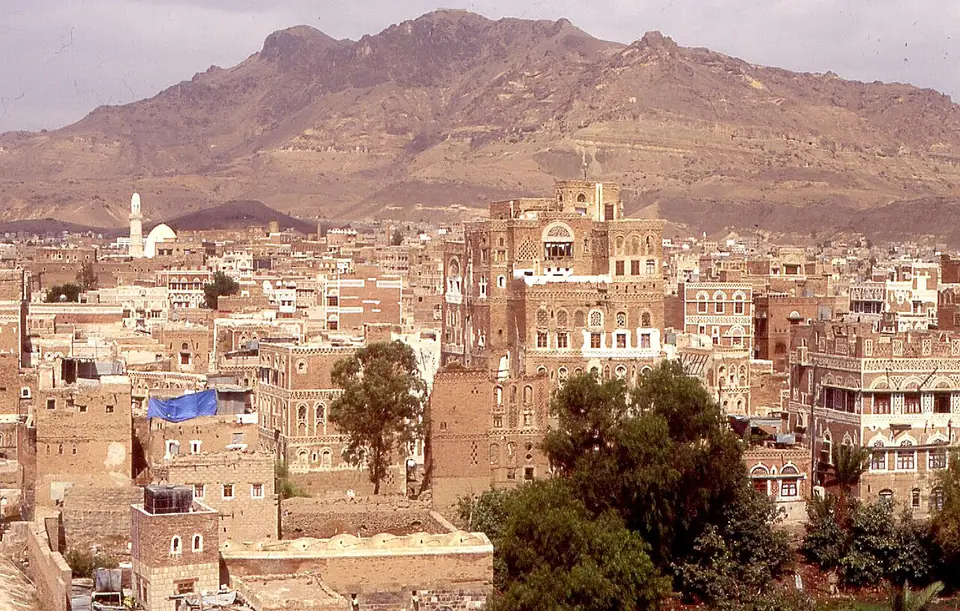
Yemen's architecture is one of its greatest treasures. Besides Sanaa, the city of Zabid on the coastal plain was a great centre of Islamic learning. Many highland houses have qamariya windows, half-moon panes of coloured glass set in gypsum that glow at night. Silversmiths, many of them once from Yemen's Jewish community, made the region famous for its jewellery.
The afternoon gathering often involves chewing qat, a mildly stimulating leaf. Sanaani song, played on the oud and a small copper drum, is recognised by UNESCO, and the bara'a dagger dance is performed at weddings. Hospitality is a point of honour, and guests are welcomed with sweet spiced tea or qishr, a drink made from coffee husks.
Five facts worth knowing
- Yemen was two countries until 1990. North Yemen, centred on Sanaa, and South Yemen, centred on Aden, united to form the present republic.
- The old city of Sanaa, with its distinctive tower houses decorated in white gypsum, is a UNESCO World Heritage Site and one of the oldest continuously inhabited cities in the world.
- Socotra Island is famous for the dragon's blood tree, a strange umbrella-shaped species found nowhere else; about a third of the island's plants are unique to it.
- Mocha, on the Red Sea coast, gave its name to coffee – Yemen was the first place where coffee was cultivated and traded on a large scale.
- Yemen is the only republic on the Arabian Peninsula; all six of its neighbours and nearby Gulf states are monarchies.
Culture and traditions in Yemen
- Saying hello
"As-salamu alaykum" with a handshake, usually between people of the same gender.
- Food and drink
Saltah, a bubbling meat stew topped with fenugreek froth; bint al-sahn, a layered honey cake.
- Festivals and traditions
Eid al-Fitr and Eid al-Adha are the main celebrations, with family visits and special foods.
- Everyday life
Afternoon social gatherings are a big part of daily life, and many men wear a jambiya, a curved dagger, as traditional dress.
- Did you know?
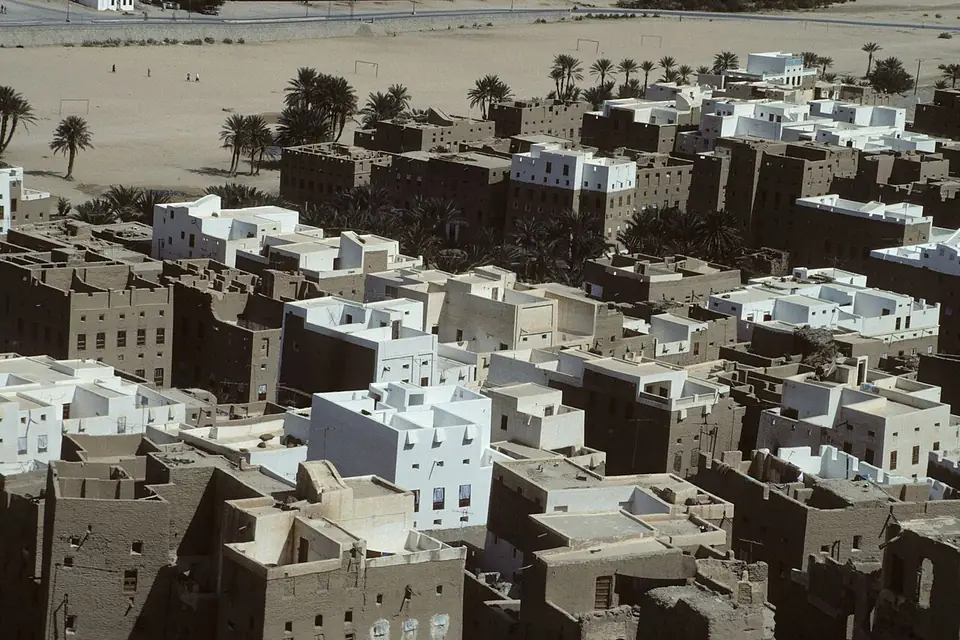
The walled city of Shibam, with mud-brick tower houses up to about 30 metres tall, is nicknamed the "Manhattan of the desert".
Common mistakes
- Tapping Oman, Yemen's eastern neighbour on the same peninsula.
- Tapping Saudi Arabia's southern region.
- Picking Egypt, Syria or Iraq in the Flags quiz – always check for an emblem in the white band.
Practise with Yemen
- Asia quiz – the south-west corner of the Arabian Peninsula.
- Middle East quiz – a zoomed map where Yemen's position next to Oman and Saudi Arabia is clear.
- Asia flags – plain red, white and black.
- Asia capitals quiz – Sanaa.
- Mystery Country – a wedge with a long Red Sea coast on the west and Socotra floating far to the east.
Nearby countries
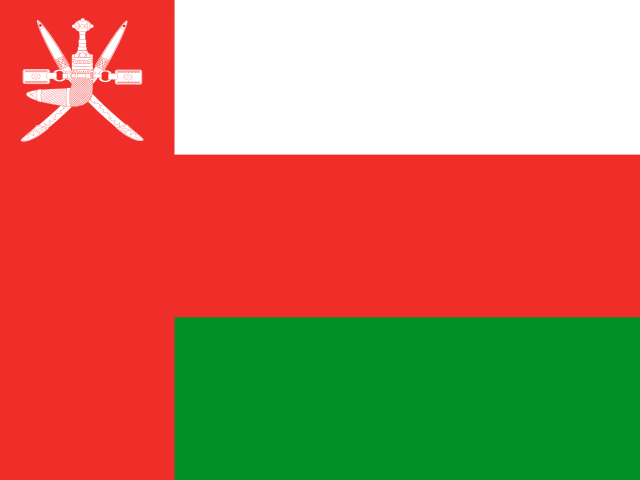 OmanMuscat
 Saudi ArabiaRiyadh
Quick check: how well do you know Yemen?
3 questions, no sign-up. Tap an answer.
1. Which flag belongs to Yemen?
That's the flag of Yemen.
2. What is the capital of Yemen?
The capital of Yemen is Sana'a.
3. Which of these countries borders Yemen?
Oman and Saudi Arabia border Yemen.
Keep going on the Asia quiz – Yemen is one of 48 countries there.
More ways to practise: find Yemen on the blank map with no borders (hard mode), or play today's Globe and the other daily puzzles.
Frequently asked questions about Yemen
What language is spoken in Yemen?
Arabic is the official language, and Yemeni dialects vary from region to region. On the island of Socotra people speak Soqotri, and Mehri is spoken in the far east – both are Modern South Arabian languages, separate from Arabic.
What currency does Yemen use?
Yemen uses the Yemeni rial (YER). Since the civil war, rival authorities have run separate central banks in Sana'a and Aden, and the rial trades at very different rates in each area, with newer banknotes accepted in only one of them.
What time zone is Yemen in?
Yemen is on UTC+3 all year, the same as Saudi Arabia. It does not use daylight saving time. That puts it level with Moscow and Nairobi, and three hours ahead of London in winter.
Which side of the road do they drive on in Yemen?
Yemen drives on the right. Aden and the south drove on the left under British rule but switched to the right in 1977, before the two Yemens united.
What is the highest point in Yemen?
The highest point is Jabal an-Nabi Shu'ayb, at about 3,670 metres, west of Sana'a. It is the highest mountain on the Arabian Peninsula. Its slopes are cut into farming terraces, typical of the Yemeni highlands.
Where does the name Mocha come from?
Mocha is a port on Yemen's Red Sea coast that was the world's main coffee market from the 1400s to the 1700s. Yemen was the first place where coffee was grown as a crop, and the port's name passed to the drink and to a style of coffee.
Quizzes with Yemen
Guides that help with this
- Oceans, seas, rivers and mountainsThe physical map: seas around each continent, the big rivers and ranges.
- Flags that look alike (and how to tell them apart)Chad or Romania? Australia or New Zealand? The flag pairs that cost quiz points.
- The 25 hardest countries to find on a mapPacific islands, Caribbean islands and landlocked Africa – where they are.