The Longest Rivers in the World – Where They Start, End and Flow
On this page
The Nile, the Amazon and the Yangtze are the big three, but the top ten has some names that surprise people, and the very first place is still argued over. This guide lists the longest rivers with where each one starts, where it ends and which countries it passes through, explains properly why the Nile–Amazon question has no single answer, and gives you a way to remember the order.
The top 12 at a glance
Lengths are the figures Britannica uses, measured to the most distant source of each river system (more on why that matters below). Treat them as rounded – other sources differ by tens or even hundreds of kilometres.
| # | River | Length | Continent | Ends in |
|---|---|---|---|---|
| 1 | Nile | 6,650 km | Africa | Mediterranean Sea |
| 2 | Amazon | 6,400 km | South America | Atlantic Ocean |
| 3 | Yangtze | 6,300 km | Asia | East China Sea |
| 4 | Mississippi–Missouri | 5,971 km | North America | Gulf of Mexico |
| 5 | Yenisei | 5,540 km | Asia | Kara Sea (Arctic) |
| 6 | Yellow River (Huang He) | 5,464 km | Asia | Bohai Sea |
| 7 | Ob–Irtysh | 5,410 km | Asia | Kara Sea (Arctic) |
| 8 | Paraná | 4,880 km | South America | Río de la Plata (Atlantic) |
| 9 | Congo | 4,700 km | Africa | Atlantic Ocean |
| 10 | Amur–Argun | 4,444 km | Asia | Sea of Okhotsk |
| 11 | Lena | 4,400 km | Asia | Laptev Sea (Arctic) |
| 12 | Mekong | 4,350 km | Asia | South China Sea |
Seven of the twelve are in Asia, and three of those – Yenisei, Ob and Lena – flow north across Siberia into the Arctic Ocean. Europe has none in the top twelve: its longest river, the Volga, is about 3,530 km.
Why river lengths disagree
Before the rivers themselves, it helps to know why two reputable books can give two different lengths. There are three choices to make, and each one moves the number.
1. Where is the source? The usual rule is to follow the longest chain of tributaries back to the most distant point that feeds the river. So the "Mississippi–Missouri" is measured from the head of the Missouri in Montana, not from Lake Itasca, where the Mississippi proper starts. The Mississippi alone is about 3,770 km; the full system is about 5,970 km.
2. Where is the mouth? Big rivers end in deltas and estuaries with several channels. Which channel you follow out to the sea can add or remove hundreds of kilometres.
3. How fine is the measurement? A river measured on a detailed map or satellite image, following every bend, comes out longer than one measured on a coarse map. Meanders also shift over time.
Nile vs Amazon: the real debate
Most reference works, including Britannica and Guinness World Records, list the Nile as the longest river at about 6,650 km and the Amazon second at about 6,400 km. The Amazon is, without any doubt, the biggest river by volume: it carries about a fifth of all the river water that reaches the world's oceans. The argument is only about length, and it comes down to the source and mouth choices above.
The Amazon's mouth. The Amazon reaches the Atlantic through several channels around Marajó Island. The southern route runs into the Pará estuary, which is usually treated as the mouth of a different river, the Tocantins. In 2007 a Brazilian team measured the Amazon out through that southern channel and got 6,992 km, against 6,853 km for the Nile. Their work was announced but never published in a peer-reviewed journal, and the choice of the southern channel is the main reason most geographers did not accept it.
The Amazon's source. For decades the source was taken to be the Apurímac river in the Peruvian Andes. A 2014 study by James Contos and Nicholas Tripcevich argued that the Mantaro river is the more distant source, which would add something like 75–90 km. That makes the Amazon longer, but not by enough on its own to pass the Nile.
The Nile's measurement. The Nile has its own uncertainty. Its most distant source is in the hills of Rwanda or Burundi, in streams that feed the Kagera river and then Lake Victoria, not at Lake Victoria itself. A 2009 satellite study by Liu and colleagues in the International Journal of Digital Earth measured the Nile at 7,088 km and the Amazon at 6,575 km.
So which is longest? It depends on where you decide the Amazon ends and begins. With the conventional choices, the Nile is longer. If you count the southern channel through the Pará estuary as the Amazon's mouth, the Amazon can come out longer. That is why the honest answer in a quiz is "the Nile, usually", and why you will see both claims online.
The big three
Nile – 6,650 km. Two main branches. The White Nile is the longer one: its headwaters are in Rwanda and Burundi, it passes through Lake Victoria and leaves it at Jinja in Uganda, then flows north through South Sudan. The Blue Nile starts at Lake Tana in Ethiopia and carries most of the water – roughly half or more of the main Nile's yearly flow, and much more in the summer flood. The two meet at Khartoum in Sudan, and the main Nile runs north through Egypt to a delta on the Mediterranean near Alexandria. Its basin covers eleven countries. Memory hook: the Nile is the river that flows north – and it is one of the few big rivers that crosses a desert without drying up.
Amazon – 6,400 km. Rises in the Peruvian Andes, not far inland from the Pacific coast, then flows east across the whole continent to the Atlantic. The main stem passes through Peru, along the Colombia–Peru border and through Brazil. In Peru the upper river is called the Marañón and Ucayali; in Brazil it is the Solimões until the Rio Negro joins it at Manaus, where it becomes the Amazon. No bridge crosses its main channel. Memory hook: starts near the Pacific, ends in the Atlantic – it crosses South America.
Yangtze – 6,300 km. The longest river that flows through just one country. It rises on the Tibetan Plateau in Qinghai and runs east through Chongqing, past the Three Gorges Dam, through Wuhan and Nanjing to the East China Sea at Shanghai. Memory hook: the Yangtze cuts China in two, north and south – Shanghai sits at its mouth.
The rest of the top twelve
Mississippi–Missouri – 5,971 km. The Missouri rises in the Rocky Mountains of Montana and joins the Mississippi at St. Louis; the Mississippi itself starts at Lake Itasca, Minnesota. Together they end in a delta on the Gulf of Mexico, about 160 km below New Orleans. The basin reaches a small piece of Canada.
Yenisei – 5,540 km. The system starts in Mongolia (the Selenga), flows into Lake Baikal, leaves it as the Angara and joins the Yenisei, which runs north through Siberia to the Kara Sea. It is the largest river by volume flowing into the Arctic.
Yellow River – 5,464 km. China's second river, from the Bayan Har Mountains in Qinghai to the Bohai Sea. It is named for the yellow loess silt it carries. It makes a huge loop to the north (the Ordos Loop) before turning south and then east. Called "China's Sorrow" for its many deadly floods.
Ob–Irtysh – 5,410 km. The Irtysh rises in the Altai in China, passes through Kazakhstan and joins the Ob in Russia. The Ob ends in the Gulf of Ob, a 1,000 km-long inlet of the Kara Sea.
Paraná – 4,880 km. Formed in southern Brazil, it flows past Paraguay and into Argentina, where it joins the Uruguay river to form the Río de la Plata, the estuary between Buenos Aires and Montevideo. The Itaipu Dam is on its Brazil–Paraguay stretch.
Congo – 4,700 km. Its farthest source, the Chambeshi, is in Zambia. It is the only major river to cross the equator twice, the deepest river ever measured (over 200 m in places), and the third-largest by flow, after the Amazon and the Ganges–Brahmaputra. Kinshasa and Brazzaville, two capitals, face each other across it.
Amur–Argun – 4,444 km. For much of its length it is the border between Russia and China. It ends in the Strait of Tartary, which opens to the Sea of Okhotsk.
Lena – 4,400 km. Rises a few kilometres west of Lake Baikal and runs north through Yakutsk to a vast delta on the Laptev Sea. The longest river entirely within Russia.
Mekong – 4,350 km. From the Tibetan Plateau through China (where it is the Lancang), along the borders of Myanmar, Laos and Thailand, through Cambodia's capital Phnom Penh, and into the South China Sea through a delta in southern Vietnam. Six countries in all.
How to remember the order
Learn the top twelve in three groups of four:
- 1–4, one per continent: Nile (Africa), Amazon (South America), Yangtze (Asia), Mississippi (North America). N-A-Y-M – "Nay, Ma".
- 5–8, mostly Asia's north: Yenisei, Yellow, Ob, Paraná – the two Y's come first, then the Ob, then the odd one out from South America.
- 9–12: Congo, Amur, Lena, Mekong – Africa, then three Asian rivers going south: Amur (border with China), Lena (Siberia), Mekong (tropics).
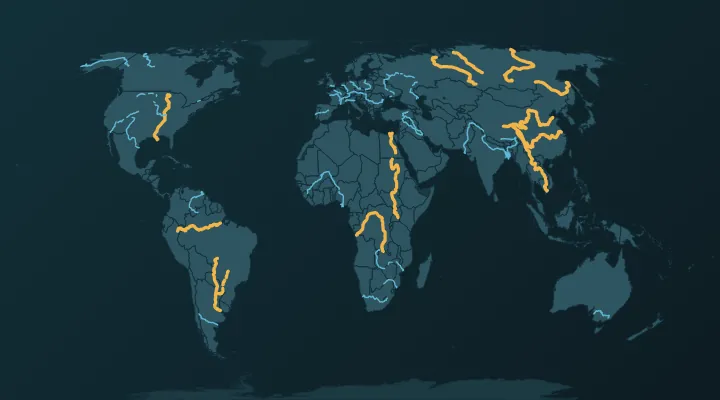
On the map, the Siberian three run west to east in the order Ob, Yenisei, Lena. The rivers quiz rewards that more than the length ranking.
Practise it
- World rivers – 41 rivers to find on the map, including all twelve above.
- World rivers – name them all – type every one from memory.
- Oceans and seas – learn the seas the rivers end in.
Tip: trace each river from source to mouth in Study mode and say the sea it ends in out loud. The next day, play the quiz cold and write down any river you tapped on the wrong line. For the bigger picture, see Oceans, seas, rivers and mountains.
FAQ
What is the longest river in the world?
The Nile, at about 6,650 km, according to most reference works. The Amazon is a close second at about 6,400 km, and some measurements put it ahead depending on where its mouth is drawn.
Is the Amazon longer than the Nile?
It can be, depending on the measurement. If the Amazon's mouth is taken through the southern channel into the Pará estuary, it can measure longer than the Nile; with the usual choice of mouth, it is shorter. The Amazon is by far the largest river by volume.
What is the longest river in Europe?
The Volga, at about 3,530 km, flowing through Russia into the Caspian Sea. The Danube, at about 2,850 km, is second and passes through ten countries.
What is the longest river in one country?
The Yangtze, at about 6,300 km, entirely within China.
Sources
- Britannica – The world's longest rivers
- Britannica – How long is the Amazon River?
- National Geographic Education – Where does the Amazon River begin?
- Liu et al. (2009), International Journal of Digital Earth – Pinpointing the sources and measuring the lengths of the principal rivers of the world
- Wikipedia – List of river systems by length (pointer to sources)
- Wikipedia – Nile (sources, flow share)
More guides
 Oceans, Seas, Rivers and Mountains – How to Learn the Physical World Map
The physical map: oceans, the seas around each continent, the big ten rivers, the major mountain ranges and deserts.
 Central America Map: All 7 Countries and Capitals, Plus Where Mexico Fits
The 7 countries of Central America and their capitals in map order, with a hook for each, plus why Mexico and the Caribbean are counted separately.
 Caribbean Countries and Capitals – All 13, With Map Hooks
All 13 Caribbean countries and capitals in map order, with hooks for the traps: Dominica, Kingston vs Kingstown, the three saints.