Polish Voivodeships capitals quiz
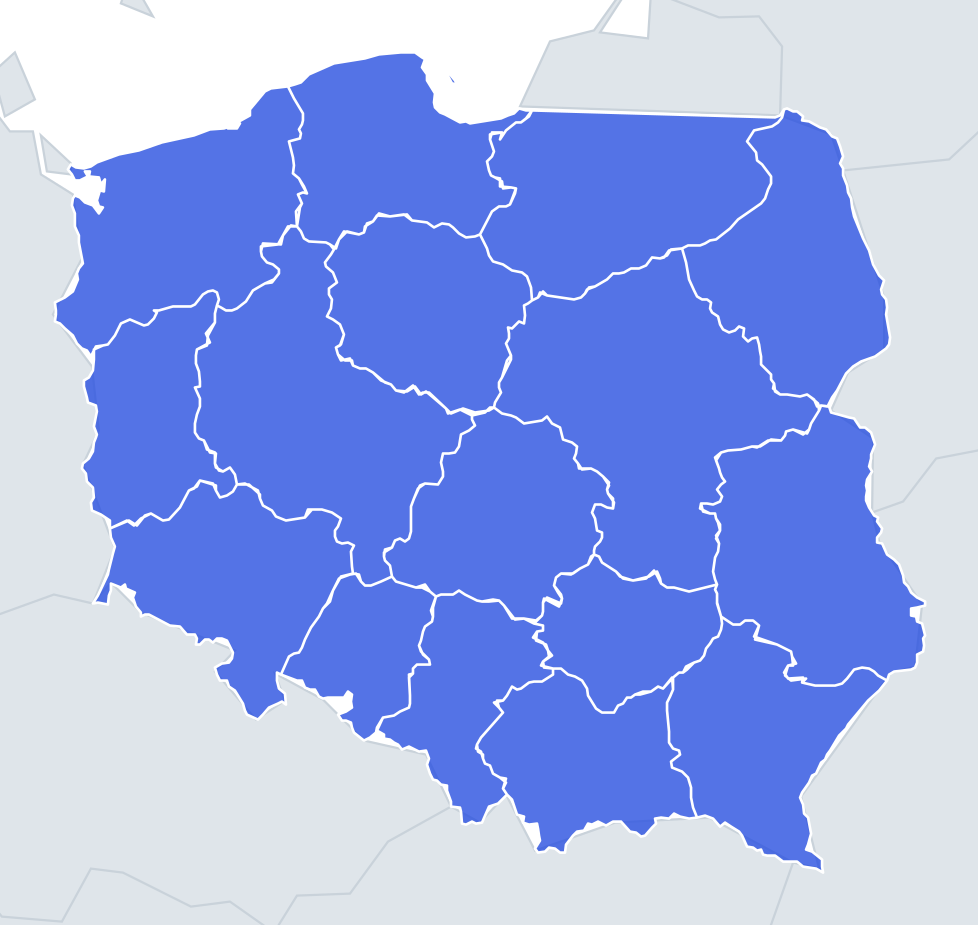
Can you place all 16 capitals of Polish Voivodeships on the map? A capital appears, you tap its dot. Three tries each, and the ones you miss come back until you know them.
Top scores
- The five fastest 100% rounds on this quiz.
Finish with 100% and post your time to get on the board – here or in full screen. All leaderboards
Your next quiz
 Dutch Provinces quiz12 provinces
 French Regions quiz13 regions
What's on this map
Sixteen voivodeships, sixteen capitals. Poland's current map dates from 1 January 1999, when a reform cut the 49 small voivodeships of 1975 down to 16 larger ones. The word itself comes from voivode, an old Slavic title for a military commander or governor.
Two voivodeships split their capital functions, a compromise from the 1999 reform. In Kuyavian-Pomeranian, Bydgoszcz is the seat of the government-appointed governor and Toruń the seat of the elected regional assembly. In Lubusz it is Gorzów Wielkopolski for the governor and Zielona Góra for the assembly. The quiz uses Bydgoszcz and Zielona Góra.
Most capitals are historic regional cities. Kraków was the royal capital of Poland until the court moved to Warsaw around 1596. Poznań, capital of Greater Poland, is linked to the earliest Polish state; the first bishopric was founded there in 968. Wrocław was the German city of Breslau until 1945, and Szczecin was Stettin; both became Polish when the borders moved west after the Second World War. Gdańsk, the former Free City of Danzig, is where the Solidarity movement was born in the shipyards in 1980.
The places people miss
- Kuyavian-Pomeranian – Bydgoszcz – not Toruń, Copernicus's birthplace, which most people know better.
- Silesian – Katowice – a coal and steel city that only received town rights in 1865.
- Subcarpathian – Rzeszów – the main city of Poland's south-east corner.
- Świętokrzyskie – Kielce – the region is named after the Holy Cross Mountains, which rise just outside the city.
- Warmian-Masurian – Olsztyn – where Copernicus lived and worked for several years.
- Podlachian – Białystok – near the Belarusian border; note the "ł".
How to learn it
- Bank the three name-twins first: Łódź, Lublin and Opole share their name with their voivodeship.
- Add the four everyone knows: Warsaw, Kraków, Gdańsk, Wrocław.
- Learn the rest by position: Szczecin (north-west coast), Poznań (west), Bydgoszcz (north centre), Olsztyn (north-east), Białystok (east), Kielce (south centre), Katowice (south), Rzeszów (south-east), Zielona Góra (west border).
- Learn the spellings with their Polish letters – Ł, ó, ń, ś, ę – so Łódź, Białystok and Rzeszów come out right.
- Done means 16 of 16 typed from memory.
Guides that help with this
- Oceans, seas, rivers and mountainsThe physical map: seas around each continent, the big rivers and ranges.
- Why you forget countries – and how spaced repetition fixes itThe forgetting curve, and how the Mistake Bank and flashcards use it.
- Flags that look alike (and how to tell them apart)Chad or Romania? Australia or New Zealand? The flag pairs that cost quiz points.
How it works
Play it as a normal quiz, beat the 60-second clock, type the answers, or try Name them all: type every capital you can remember before time runs out.
All 16 capitals of Polish Voivodeships
| Voivodeship | Capital |
|---|---|
| Greater Poland | Poznań |
| Kuyavian-Pomeranian | Bydgoszcz |
| Lesser Poland | Kraków |
| Łódź | Łódź |
| Lower Silesian | Wrocław |
| Lublin | Lublin |
| Lubusz | Zielona Góra |
| Masovian | Warsaw |
| Opole | Opole |
| Podlachian | Białystok |
| Pomeranian | Gdańsk |
| Silesian | Katowice |
| Subcarpathian | Rzeszów |
| Świętokrzyskie | Kielce |
| Warmian-Masurian | Olsztyn |
| West Pomeranian | Szczecin |