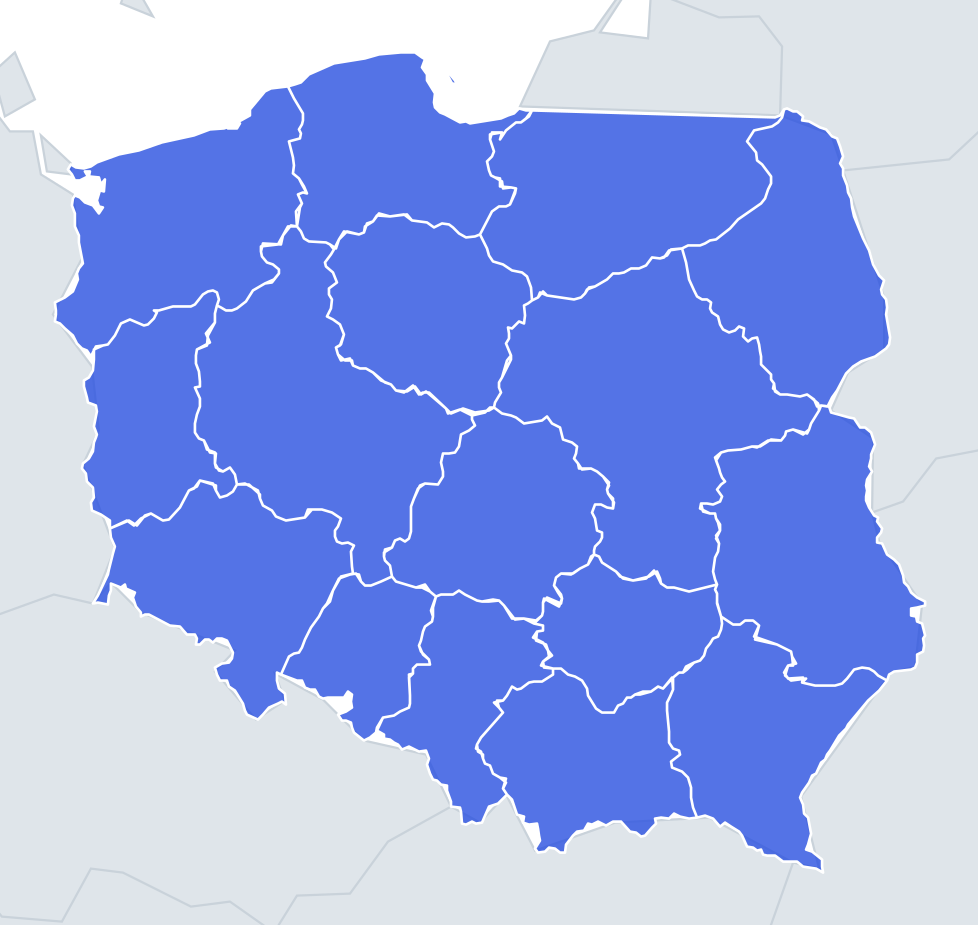
Name all 16 Polish Voivodeships
No map hints and no multiple choice: just type every one you can remember. Each correct answer lights up on the map, and the clock keeps running until you give up or get all 16.
Top scores
- The five fastest 100% rounds on this quiz.
Finish with 100% and post your time to get on the board – here or in full screen. All leaderboards
Your next quiz
 Dutch Provinces quiz12 provinces
 French Regions quiz13 regions
What's on this map
Sixteen voivodeships to type from memory. Most of the names are old historical regions rather than cities, and knowing what each region is helps them come back. Pomerania means "the land by the sea" in Slavic, so Pomeranian and West Pomeranian are the coast. Silesia is the south-west, a coal and industrial region that belonged to Bohemia, Austria and Prussia before most of it became Polish in 1945. Masovia is the land around Warsaw, once a separate duchy.
Greater Poland (Wielkopolska) and Lesser Poland (Małopolska) are the two historical cores of the Polish state, around Poznań and Kraków. "Greater" here means older, not larger – Greater Poland was the heartland of the first Polish rulers in the 900s. Kuyavia is a small historical region around the Vistula, and Warmia and Masuria are former parts of East Prussia, German until 1945. Subcarpathian is simply "below the Carpathians". Świętokrzyskie is named after the Holy Cross Mountains, and Lubusz after the old Lubusz Land on the Oder.
Three voivodeships are named after their capital city: Łódź, Lublin and Opole.
The places people miss
- Świętokrzyskie – the hardest spelling: Ś-w-i-ę-t-o-k-r-z-y-s-k-i-e. It is usually left untranslated.
- Kuyavian-Pomeranian – a double name with a hyphen; people type only "Pomeranian" and lose the point.
- Warmian-Masurian – also a double name, also hyphenated.
- Lubusz – the least-known name on the list; picture the German border.
- Podlachian – also written Podlaskie; the quiz uses Podlachian.
- West Pomeranian vs Pomeranian – two separate answers; type both.
How to learn it
- Sweep the map in three rows from west to east. North: West Pomeranian, Pomeranian, Warmian-Masurian. Middle: Lubusz, Greater Poland, Kuyavian-Pomeranian, Łódź, Masovian, Podlachian. South: Lower Silesian, Opole, Silesian, Świętokrzyskie, Lesser Poland, Subcarpathian, Lublin.
- Count each row: 3, 6, 7.
- Pair the related names: Greater and Lesser Poland, Pomeranian and West Pomeranian, Silesian and Lower Silesian.
- Done means 16 of 16 typed with no hesitation on the double names.
Guides that help with this
- Oceans, seas, rivers and mountainsThe physical map: seas around each continent, the big rivers and ranges.
- Why you forget countries – and how spaced repetition fixes itThe forgetting curve, and how the Mistake Bank and flashcards use it.
- Flags that look alike (and how to tell them apart)Chad or Romania? Australia or New Zealand? The flag pairs that cost quiz points.
How it works
Type a name and press enter. Spelling is forgiving: accents, capital letters and common alternative names are all accepted. When you stop, the ones you missed are shown on the map so you know which to practise next time.
Most people get well under half on the first try. Play the map quiz a few times first, then come back and see how many you can name.
Answer list (16 voivodeships)
Show all 16 answers (spoilers)
- Greater Poland
- Kuyavian-Pomeranian
- Lesser Poland
- Łódź
- Lower Silesian
- Lublin
- Lubusz
- Masovian
- Opole
- Podlachian
- Pomeranian
- Silesian
- Subcarpathian
- Świętokrzyskie
- Warmian-Masurian
- West Pomeranian