Guyana
Capital: Georgetown. Guyana is one of the 12 countries in the South America quiz.
Quick answers: What is the capital of Guyana? · Which countries border Guyana?
Facts about Guyana
- CapitalGeorgetown
- Population835,986
- Area214,969 km²
- RegionSouth America
- LanguageEnglish
- CurrencyGuyanese dollar (GYD)
Guyana is the 11th most populous of the 12 countries in South America and the 10th largest by area. Worldwide it ranks 163rd by population and 83rd by area.
Where is Guyana?
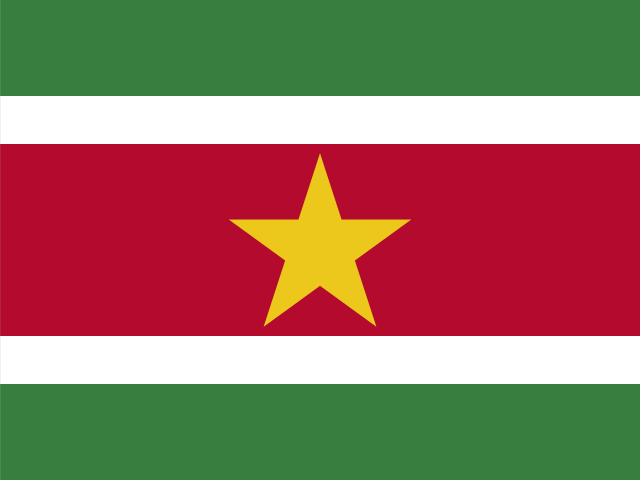
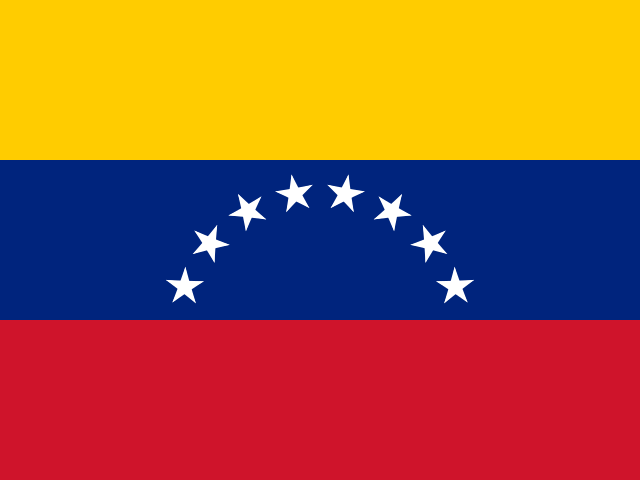
Guyana is on the north-east coast of South America, between Venezuela to the west and Suriname to the east, with Brazil along its southern border. Its northern edge is the Atlantic Ocean. It is one of the three small countries – with Suriname and French Guiana – on the continent's "shoulder" next to giant Brazil. The capital, Georgetown, is on the coast at the mouth of the Demerara River.
Most of the population lives on a narrow coastal plain; inland, the country is rainforest and savannah.
How to find Guyana on the map
- Start from Venezuela. Follow the north coast of South America eastward from Venezuela; the first small country you reach is Guyana.
- It's the first of three. Guyana, Suriname and French Guiana sit side by side from west to east. Guyana is the westernmost and the largest.
- Look north of Brazil. Guyana sits on Brazil's northern border, directly above the state of Roraima.
- Don't confuse it with Guinea. Guyana is in South America; Guinea and Guinea-Bissau are in West Africa.
Flag
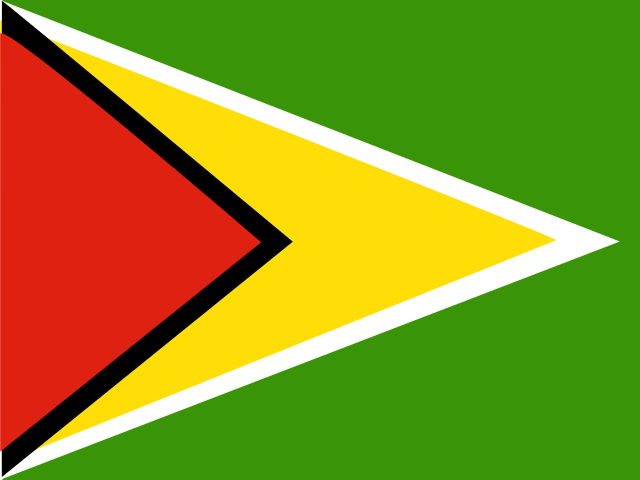
Guyana's flag is called the Golden Arrowhead. On a green field, a yellow triangle stretches from the hoist to the fly tip, edged in white, with a smaller red triangle edged in black at the hoist. Green stands for the forests, yellow for mineral wealth, red for energy and black for endurance.
It was designed by the American vexillologist Whitney Smith and adopted at independence in 1966. The arrow shape is unique among national flags, so in the Flags quiz anything with nested triangles pointing right is Guyana.
A short history of Guyana
The name Guyana comes from an Amerindian word often translated as "land of many waters". Arawak, Carib and Warao peoples lived along its rivers and coast for thousands of years, and their descendants still make up about a tenth of the population, mostly in the interior.
The Dutch arrived in the early 1600s and set up three separate colonies along the Essequibo, Demerara and Berbice rivers. They brought enslaved Africans to clear the coastal swamps and grow sugar, using the same dykes and canals as at home. In 1763 an enslaved man named Cuffy led a revolt in Berbice that held much of the colony for months; he is now Guyana's national hero, and the anniversary of the uprising is still marked.
Britain captured the colonies during the Napoleonic Wars, kept them in 1814 and merged them into British Guiana in 1831. After slavery ended in the 1830s, many freed people left the plantations, so planters brought in indentured labourers. Between 1838 and 1917 roughly 240,000 came from India, along with smaller numbers from Madeira and China. Indo-Guyanese became the largest group, and that mix still shapes politics and daily life.
From the 1950s, the struggle for independence was led by Cheddi Jagan and Forbes Burnham, who started as allies and became rivals; their parties drew largely on Indian and African voters respectively. Guyana became independent in 1966 and a republic in 1970. Burnham ruled until 1985, nationalising most of the economy. In 1978 the country made world news when more than 900 members of an American cult died at Jonestown in the north-west jungle.
The borders still reflect the Dutch river colonies and British survey lines, Venezuela and Suriname each claim parts of Guyana's territory, while Guyana holds that its borders are settled, citing an 1899 arbitral award in the case of Venezuela. Georgetown is the headquarters of CARICOM, the Caribbean Community.
Culture and daily life in Guyana
Guyana feels more Caribbean than South American. English is official, Guyanese Creole is spoken by almost everyone, and the country plays a full part in West Indian life. Around a quarter of people are Hindu, alongside Christians and Muslims, and Diwali, Eid and Christmas are all public holidays.
Writers from Guyana have made a mark well beyond its size. Wilson Harris wrote the visionary novel Palace of the Peacock, and E.R. Braithwaite's To Sir, With Love, about teaching in London, became a famous film. In cricket, Clive Lloyd captained the West Indies to their first two World Cup victories, in 1975 and 1979.
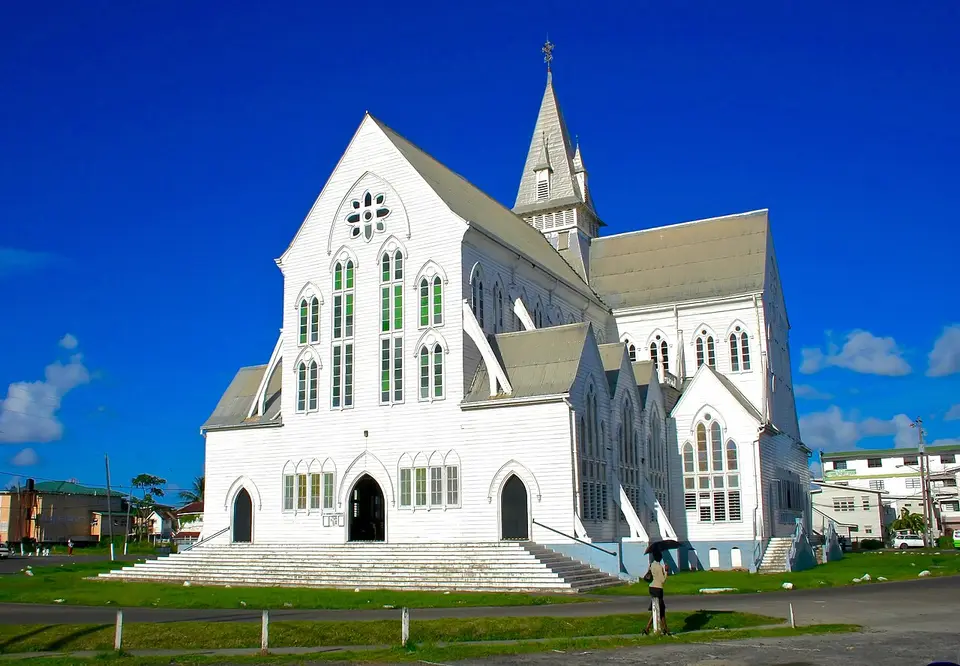
Music mixes calypso, soca, reggae and chutney, which blends Indian folk songs with Caribbean rhythms. In the southern Rupununi savannahs, Amerindian and mixed-heritage cowboys hold an Easter rodeo at Lethem. In Georgetown, the wooden St George's Cathedral and the iron Stabroek Market clock tower are landmarks. Amerindian communities in the interior keep traditions of basket-weaving and cassava bread-making, and Amerindian Heritage Month is celebrated every September.
Five facts worth knowing
- Guyana is the only English-speaking country in South America, a legacy of British rule, and it plays cricket rather than football as its main sport.
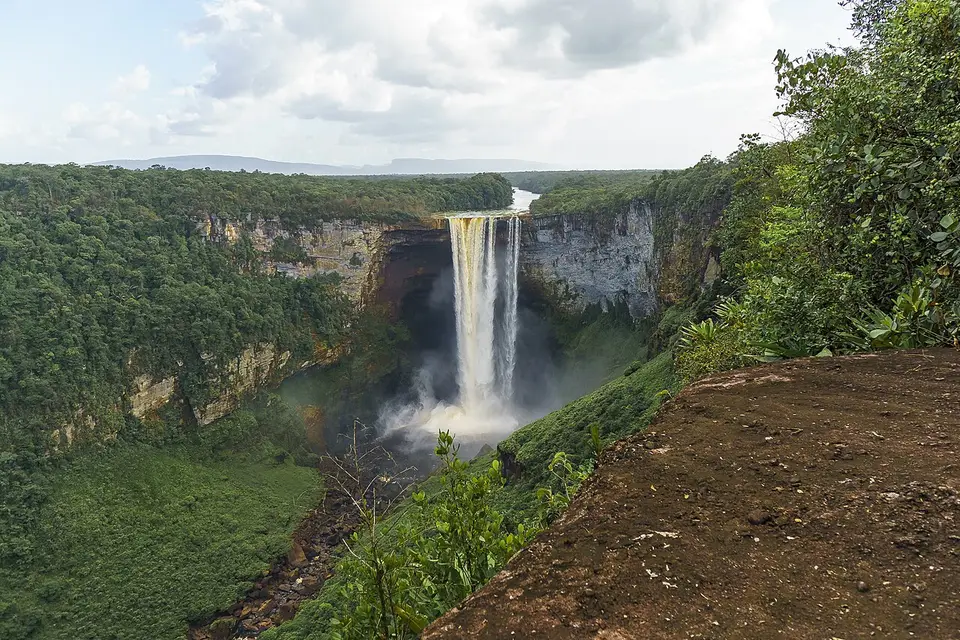
- Kaieteur Falls, on the Potaro River, is one of the most powerful waterfalls in the world, with a single drop of about 226 metres – more than four times the height of Niagara.
- Huge offshore oil discoveries since 2015 have made Guyana one of the fastest-growing economies on Earth.
- Venezuela claims the Essequibo region, roughly two-thirds of Guyana's territory, in a dispute dating back to the 19th century.
- Georgetown lies below sea level at high tide and is defended by a sea wall built in the Dutch and British colonial eras.
Culture and traditions in Guyana
- Saying hello
A friendly "Good morning" or "Hello" in English or Guyanese Creole.
- Food and drink
Pepperpot, a slow-cooked meat stew with cassareep, traditional at Christmas; cook-up rice with beans and meat.
- Festivals and traditions
Mashramani on 23 February, Republic Day carnival; Phagwah (Holi) in March.
- Everyday life
Cultures of Indian, African, Amerindian, Chinese and European descent blend in food and festivals. Cricket is hugely popular.
- Did you know?
Guyana is the only country in South America with English as its official language.
Common mistakes
- Tapping Suriname, the similar-sized neighbour to the east.
- Tapping French Guiana, which is part of France and not a separate country.
- Mixing up Guyana with Guinea or Ghana because of the similar names.
Practise with Guyana
- South America quiz – find the three small countries on the north-east coast; Guyana is the first.
- North America flags – the Golden Arrowhead is one of the easiest flags in the set.
- Whole World quiz – harder at full zoom; aim for the coast just east of Venezuela.
- South America capitals quiz – Georgetown.
- Mystery Country – a roughly rectangular outline with a coastline on top and a river border with Suriname.
Nearby countries
Quick check: how well do you know Guyana?
3 questions, no sign-up. Tap an answer.
1. Which flag belongs to Guyana?
That's the flag of Guyana.
2. What is the capital of Guyana?
The capital of Guyana is Georgetown.
3. Which of these countries borders Guyana?
Brazil, Suriname and Venezuela border Guyana.
Keep going on the South America quiz – Guyana is one of 12 countries there.
More ways to practise: find Guyana on the blank map with no borders (hard mode), or play today's Globe and the other daily puzzles.
Frequently asked questions about Guyana
What language is spoken in Guyana?
English is the official language, a legacy of British rule, and Guyana is the only English-speaking country in South America. Most people use Guyanese Creole in everyday life, and several Amerindian languages such as Wapishana and Makushi are spoken in the interior.
What currency does Guyana use?
Guyana uses the Guyanese dollar (GYD), issued by the Bank of Guyana. It replaced the British West Indies dollar in 1965, the year before independence, and is divided into 100 cents, though small coins are rarely seen.
What time zone is Guyana in?
Guyana is on UTC−4 all year and does not use daylight saving time. That puts it one hour behind Suriname and in the same time as most of Venezuela and the Brazilian state of Roraima on its borders.
Which side of the road do they drive on in Guyana?
Guyana drives on the left, a habit inherited from British colonial rule. Together with neighbouring Suriname, it is one of only two countries in South America that drive on the left; everywhere else on the continent traffic keeps right.
What is the highest point in Guyana?
Guyana's highest ground is on Mount Roraima, the flat-topped tepui where Guyana, Brazil and Venezuela meet. Its very top, about 2,810 metres, lies in Venezuela, while Guyana's part reaches roughly 2,770 metres. Its sheer cliffs inspired Arthur Conan Doyle's The Lost World.
Is Guyana part of the Caribbean?
Geographically Guyana is in South America, but culturally and politically it belongs with the Caribbean. It is a founding member of CARICOM, and Guyanese cricketers play for the West Indies team, which represents former British territories in the region.
Quizzes with Guyana
Often confused with
Guides that help with this
- Oceans, seas, rivers and mountainsThe physical map: seas around each continent, the big rivers and ranges.
- Flags that look alike (and how to tell them apart)Chad or Romania? Australia or New Zealand? The flag pairs that cost quiz points.
- The 25 hardest countries to find on a mapPacific islands, Caribbean islands and landlocked Africa – where they are.