Mauritania
Capital: Nouakchott. Mauritania is one of the 54 countries in the Africa quiz.
Quick answers: What is the capital of Mauritania? · Which countries border Mauritania?
Facts about Mauritania
- CapitalNouakchott
- Population5.3 million
- Area1,030,700 km²
- RegionsAfrica, West Africa
- LanguageArabic
- CurrencyMauritanian ouguiya (MRU)
Mauritania is the 39th most populous of the 54 countries in Africa and the 11th largest by area. Worldwide it ranks 125th by population and 28th by area.
Where is Mauritania?
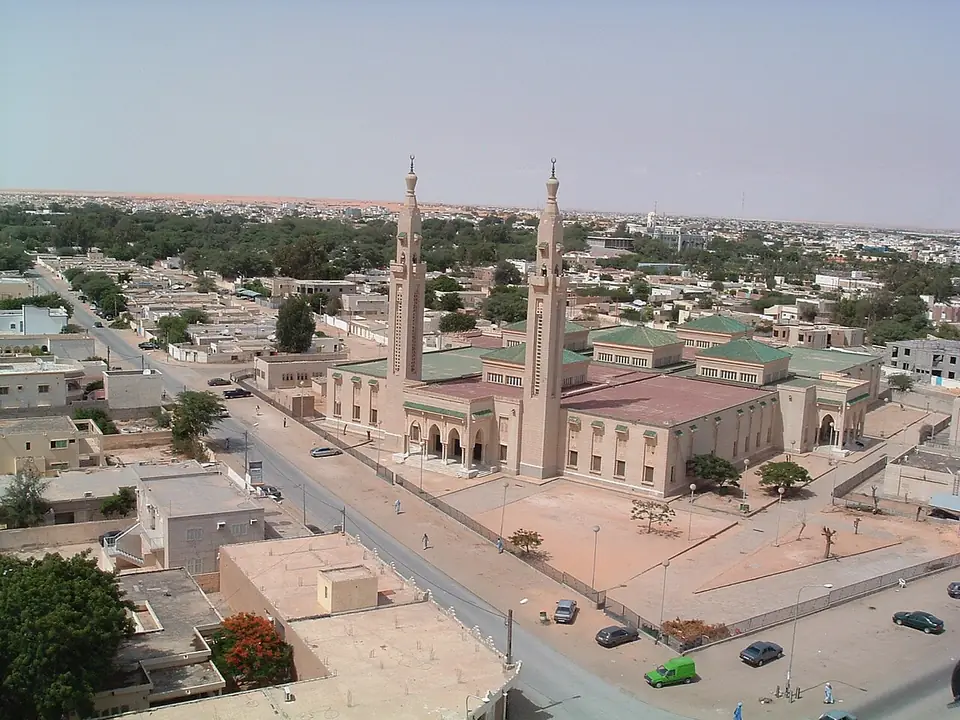
Mauritania is a large, mostly desert country on the Atlantic coast of north-west Africa. Western Sahara and Algeria are to the north, Mali to the east and south, and Senegal to the south across the Senegal River. The capital, Nouakchott, is on the coast about a third of the way up. The northern two-thirds are Sahara; most people live in the south along the river and on the coast.
On a world map, find the westernmost bulge of Africa. Senegal is the small country at the tip, with the Gambia inside it. Mauritania is the big country stacked directly above Senegal, running up the coast towards Western Sahara.
How to find Mauritania on the map
- Start from Senegal. Mauritania is the much larger country immediately north of it.
- Follow the Atlantic coast north from Dakar. The next country up is Mauritania, and it continues for hundreds of kilometres.
- Look for the straight eastern border. Much of the border with Mali is drawn with long straight desert lines.
- Don't confuse it with Mali. Mali is inland and east. Mauritania is the one with the coast.
Flag
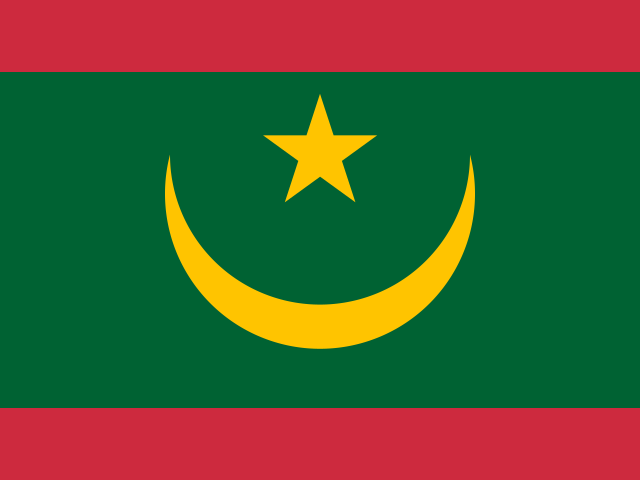
Mauritania's flag is green with a gold crescent and star in the centre, and since 2017 a red horizontal stripe along the top and bottom edges. The green and the crescent and star represent Islam – the country's official name is the Islamic Republic of Mauritania – and the gold stands for the Sahara sands. The red stripes were added by referendum to honour those who died resisting French colonisation.
The crescent points upwards with the star above it, which is unusual. Pakistan also has a crescent and star on green, but with a white hoist band and a tilted crescent. Green with red edges and an upturned crescent is Mauritania.
A short history of Mauritania
Rock paintings of cattle and giraffes in the north show that the Sahara was once much greener. As it dried, people moved south, and by the first millennium AD the south-east of today's Mauritania was the heart of the Ghana Empire, whose capital, Koumbi Saleh, lay near the modern border with Mali.
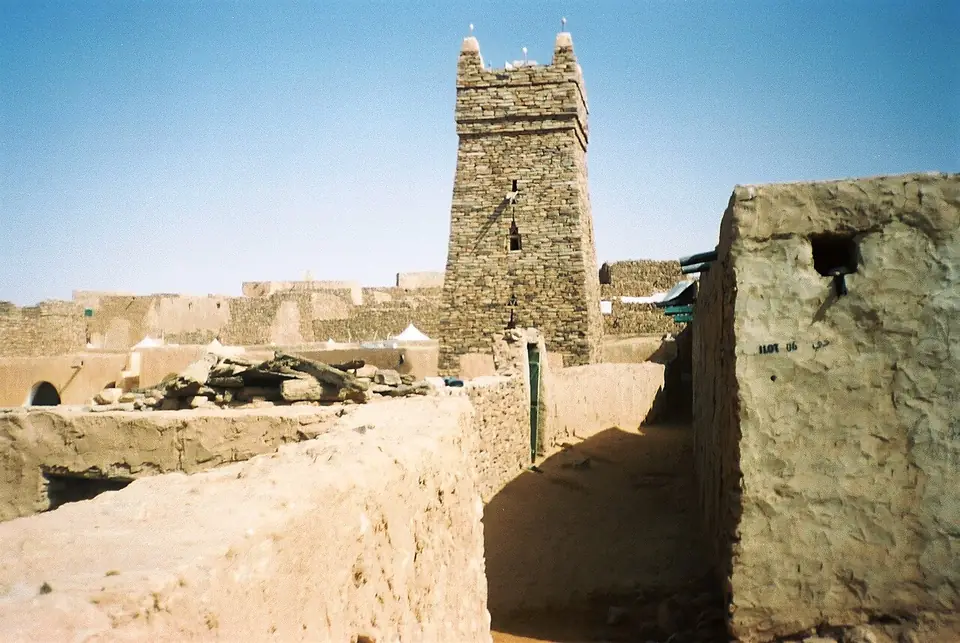
In the 11th century a movement of Sanhaja Berber nomads from this region, the Almoravids, launched a religious campaign that swept north and built an empire stretching from the Senegal River to Spain. Trade caravans crossed the desert, and towns such as Chinguetti, Ouadane and Oualata grew into centres of commerce and Islamic learning.
From the 14th century Arab tribes known as the Beni Hassan moved into the area. Their Arabic dialect, Hassaniya, gradually replaced Berber, and by the 1600s the region was divided into emirates such as Trarza, Brakna, Adrar and Tagant. Society was organised into warrior and scholarly clans, with a strict social hierarchy beneath them.
France pushed north from Senegal around 1900 and made Mauritania a colony in 1920. It was ruled from Saint-Louis, across the river in Senegal, which is why the country needed a brand-new capital at independence. Mauritania became independent in 1960 under Moktar Ould Daddah. Morocco at first claimed the whole territory and only recognised it in 1969.
In 1975–76 Spain withdrew from Western Sahara, and Mauritania and Morocco divided the territory between them. Mauritania soon found itself fighting the Polisario Front, which seeks independence for Western Sahara, while Morocco regards the territory as its own. The war was costly, and after a military coup in 1978 Mauritania gave up its claim in 1979. Further coups followed in 1984, 2005 and 2008, and the first handover between two elected presidents came only in 2019.
Today the economy rests on iron ore, gold and some of the richest fishing waters in the world, and a large offshore gas field shared with Senegal has opened a new chapter.
Culture and daily life in Mauritania
Mauritania is often called the "land of a million poets", and poetry in Hassaniya and classical Arabic is still recited at gatherings and broadcast on radio. The desert towns preserve family libraries of old manuscripts on religion, law, astronomy and medicine, some of them centuries old.
Most of the population speaks Hassaniya Arabic, but the communities along the Senegal River speak Pulaar, Soninke and Wolof, reflecting the country's position between the Arab world and sub-Saharan Africa. French remains widely used in business. Almost everyone is Sunni Muslim, following the Maliki school.
Traditional music is played by hereditary musician families called iggawen. Men play the tidinit, a small lute, while women play the ardin, a harp made from a large gourd. The singer Dimi Mint Abba made this music known abroad. In dress, men often wear the flowing blue or white daraa, and women wrap themselves in a long, colourful cloth called a melhfa. Many urban families still keep close ties to nomadic life, returning to the desert with tents and camels during the rainy season.
Five facts worth knowing
- Mauritania was the last country in the world to abolish slavery, in 1981, and only criminalised it in 2007.
- The Richat Structure, or "Eye of the Sahara", is a circular rock formation about 40 km across near Ouadane, so distinctive that astronauts use it as a landmark from orbit.
- Nouakchott was a small village until it was chosen as capital in the late 1950s and is now one of the largest cities in the Sahara.
- The iron-ore railway from Zouérat to the port of Nouadhibou runs trains up to 2.5 km long, among the longest in the world.
- Mauritania sits on the boundary between Arab North Africa and sub-Saharan West Africa, and is a member of the Arab League.
Culture and traditions in Mauritania
- Saying hello
"Assalamu alaikum" with a handshake; greetings include several questions about family and wellbeing.
- Food and drink
Thieboudienne, fish and rice, and camel or goat dishes; mint green tea is served in three glasses of varying sweetness.
- Festivals and traditions
Independence Day on 28 November; the Festival of Ancient Cities rotates between historic desert towns like Chinguetti and Ouadane.
- Everyday life
Tea ceremonies are an important social ritual, and hospitality to guests is a strong duty. Modest dress is expected in public.
- Did you know?
The Richat Structure, or "Eye of the Sahara", is a 40 km-wide circular rock formation visible from space.
Common mistakes
- Tapping Mali – the inland neighbour with a similar desert outline.
- Tapping Western Sahara or Morocco to the north.
- Confusing the flag with Pakistan's.
Practise with Mauritania
- West Africa quiz – the large coastal country above Senegal.
- Africa quiz – find the westernmost point of the continent and go north.
- Africa flags – green with the upturned crescent and red edge stripes.
- Africa capitals quiz – Nouakchott.
- Mystery Country – a big block with a coast on the left and a notch in the north-west where Western Sahara cuts in.
Nearby countries
Quick check: how well do you know Mauritania?
3 questions, no sign-up. Tap an answer.
1. Which flag belongs to Mauritania?
That's the flag of Mauritania.
2. What is the capital of Mauritania?
The capital of Mauritania is Nouakchott.
3. Which of these countries borders Mauritania?
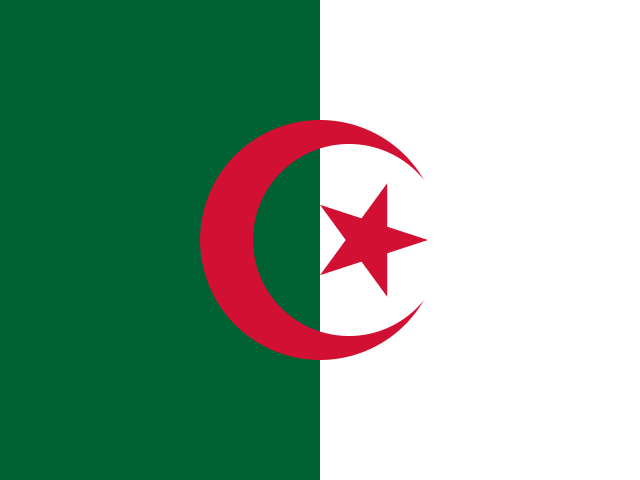
Algeria, Mali and Senegal border Mauritania.
Keep going on the Africa quiz – Mauritania is one of 54 countries there.
More ways to practise: find Mauritania on the blank map with no borders (hard mode), or play today's Globe and the other daily puzzles.
Frequently asked questions about Mauritania
What language is spoken in Mauritania?
Arabic is the official language, and most people speak Hassaniya, the local Arabic dialect of the western Sahara. Pulaar, Soninke and Wolof are national languages spoken mainly in the south along the Senegal River, and French remains common in business and higher education.
What currency does Mauritania use?
Mauritania uses the ouguiya (MRU). It is one of only two currencies in the world that is not divided into hundredths: one ouguiya equals five khoums. A new ouguiya was introduced in 2018, worth ten of the old ones.
What time zone is Mauritania in?
Mauritania is on UTC+0 all year and does not use daylight saving time. It shares this time with its neighbours Senegal and Mali, so clocks in Nouakchott match Greenwich Mean Time.
Which side of the road do they drive on in Mauritania?
Mauritania drives on the right. The main paved road runs along the coast from Nouadhibou through Nouakchott to Rosso on the Senegal River, while much of the interior is crossed on desert tracks.
What is the highest point in Mauritania?
Kediet ej Jill, a mountain near the mining town of Zouérat in the north, is Mauritania's highest point at about 915 metres. It is rich in iron ore and its magnetic rock is said to disturb compasses.
What is the Mauritania iron ore train?
It is one of the longest and heaviest trains in the world, often over two kilometres long. It carries iron ore about 700 kilometres from the mines at Zouérat across the Sahara to the port of Nouadhibou, and some travellers ride on top of the ore wagons.
Quizzes with Mauritania
Guides that help with this
- Learn all 54 African countries in a weekLearn the coastline in order, region by region.
- Flags that look alike (and how to tell them apart)Chad or Romania? Australia or New Zealand? The flag pairs that cost quiz points.
- The 25 hardest countries to find on a mapPacific islands, Caribbean islands and landlocked Africa – where they are.