Moldova
Capital: Chișinău. Moldova is one of the 46 countries in the Europe quiz.
Quick answers: What is the capital of Moldova? · Which countries border Moldova?
Facts about Moldova
- CapitalChișinău
- Population2.4 million
- Area33,846 km²
- RegionsEurope, The Balkans, Central & Eastern Europe
- LanguageRomanian
- CurrencyMoldovan leu (MDL)
Moldova is the 30th most populous of the 46 countries in Europe and the 32nd largest by area. Worldwide it ranks 144th by population and 136th by area.
Where is Moldova?
Moldova is a small landlocked country in Eastern Europe, wedged between Romania to the west and Ukraine on every other side. The Prut River forms the whole western border with Romania, and the Dniester runs down the eastern side. The capital, Chișinău, is in the centre. Moldova is only about 350 km from north to south and never more than about 150 km wide.
On a world map, find Romania on the Black Sea coast, then look at the country immediately to its north-east. Moldova is the narrow strip between Romania and the main body of Ukraine, stopping just short of the sea.
How to find Moldova on the map
- Start from Romania. Moldova is the thin country along Romania's north-eastern edge, across the Prut.
- Look inside Ukraine's curve. Ukraine wraps around Moldova's north, east and south, so Moldova looks like a notch cut into Ukraine.
- Check the coast. Moldova comes within a few kilometres of the Black Sea but has no coastline – a tiny stretch of the Danube at Giurgiulești is its only river port.
- Don't confuse it with Romania. Romania is far larger, with the Carpathians and a Black Sea coast.
Flag
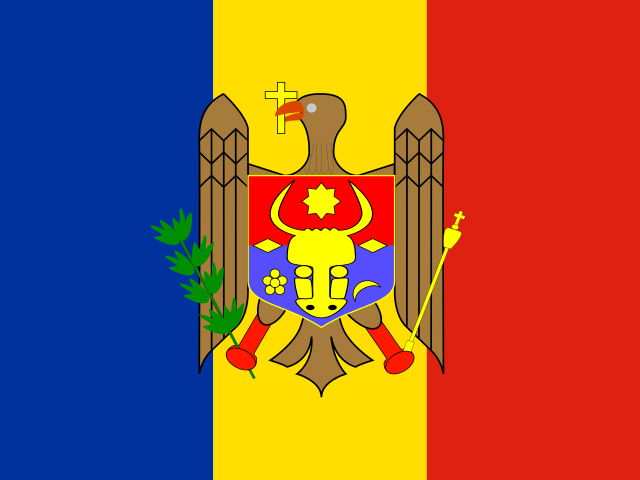
Moldova's flag is a vertical tricolour of blue, yellow and red, identical in colours and layout to Romania's, with the Moldovan coat of arms in the centre of the yellow band. The arms show an eagle holding a shield with an aurochs head, the historic symbol of the medieval Principality of Moldavia. The shared colours reflect the close ties between the two countries; most Moldovans speak Romanian.
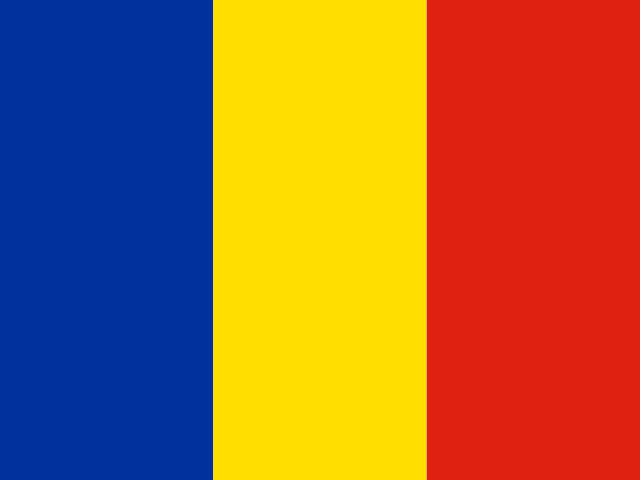
In the Flags quiz, Romania is the plain tricolour, Moldova the one with the eagle. Chad is also blue-yellow-red with no emblem but a darker blue, and Andorra carries its own coat of arms.
A short history of Moldova
In ancient times the land between the Prut and the Dniester was home to Dacian and Thracian tribes, and later saw waves of Goths, Slavs, Bulgars and Mongols pass through. The modern story begins in the 14th century, when the Principality of Moldavia was founded east of the Carpathians. Its most famous ruler, Stephen the Great, held off Ottoman, Hungarian and Polish armies in the late 1400s and built monasteries that still stand.
From the 1500s Moldavia was a vassal of the Ottoman Empire, keeping its own princes but paying tribute. In 1812, after a war with the Ottomans, Russia annexed the eastern half of Moldavia, the land between the Prut and the Dniester, and called it Bessarabia. The western half later joined Wallachia to form Romania. This split explains why Moldova and Romania share a language but became separate countries.
After the Russian Revolution, Bessarabia united with Romania in 1918. The Soviet Union never accepted this. A narrow strip east of the Dniester, which had stayed Soviet, was made into an autonomous republic in 1924. In 1940, after the pact between Hitler and Stalin, the USSR took Bessarabia and joined most of it to that strip to form the Moldavian Soviet Socialist Republic. The new republic lost its coast and its southern districts to Ukraine, which is why Moldova today stops just short of the Black Sea.
Under Soviet rule, the language was written in Cyrillic and called "Moldovan" to set it apart from Romanian. In 1989 a national movement restored the Latin alphabet, and Moldova declared independence in August 1991. Fighting with Russian-backed separatists in Transnistria followed, and Russian troops have remained there since.
Moldova has since swung between pro-Russian and pro-European governments. Today it is one of Europe's poorer countries, relying on farming, wine and money sent home by workers abroad, while it moves step by step towards the EU.
Culture and daily life in Moldova
The official language is Romanian, and most people speak it at home, but Russian is still widely used in cities and in Transnistria, and Ukrainian, Gagauz and Bulgarian are spoken by minorities. Choosing which language to speak can carry political meaning, a lasting effect of the Soviet years. Around nine in ten people are Orthodox Christians.
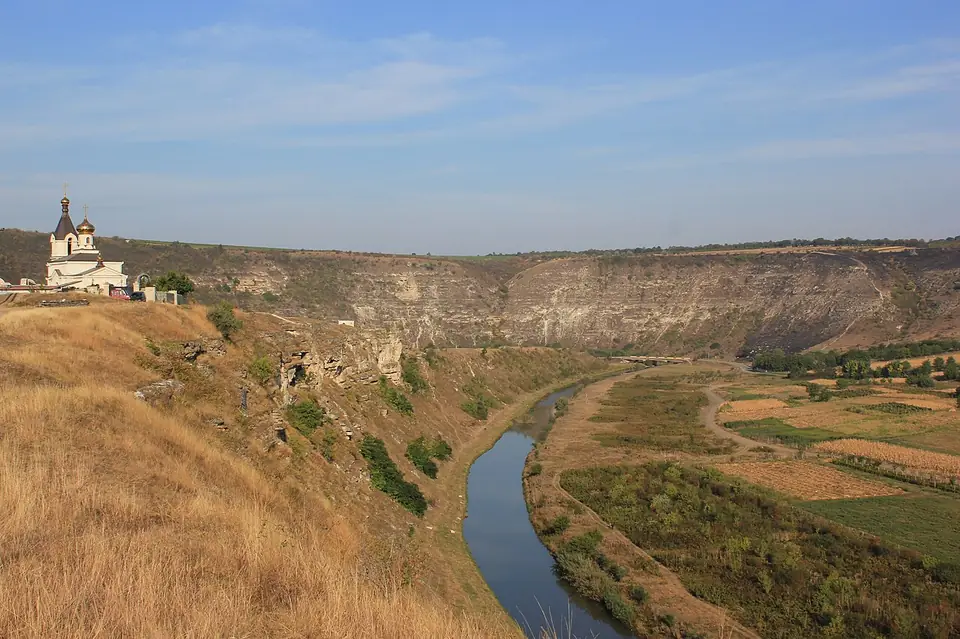
Monasteries are some of Moldova's most striking sights. At Orheiul Vechi, monks carved cells and a church into a limestone cliff above a looping river, and the monasteries of Căpriana and Curchi are important places of pilgrimage. The poet Mihai Eminescu, claimed by both Romanians and Moldovans, is honoured with statues across the country, and Alexei Mateevici's poem "Limba noastră" ("Our Language") became the national anthem.
Folk music with fiddles, cimbalom and the nai panpipe is played at weddings, which can be enormous, all-night celebrations. The hora, a circle dance, brings whole villages together. Many people grow their own grapes and make wine at home. Moldova is also known abroad for the pop hit "Dragostea din tei" by the band O-Zone, and for its colourful entries at the Eurovision Song Contest.
Five facts worth knowing
- Transnistria, a strip along the eastern bank of the Dniester, has been outside government control since a war in 1992. It runs its own administration but is recognised by no UN member.
- Moldova has some of the largest wine cellars in the world. The Mileștii Mici cellars stretch for around 200 km of underground tunnels.
- The country became independent from the Soviet Union in 1991 and was granted EU candidate status in 2022.
- Gagauzia, in the south, is an autonomous region whose people speak a Turkic language and are mostly Orthodox Christian.
- Moldova is one of the least visited countries in Europe, a largely rural landscape of vineyards and rolling hills.
Culture and traditions in Moldova
- Saying hello
People shake hands and say "Bună ziua" in Romanian; Russian is also widely spoken.
- Food and drink
Mămăligă, a polenta-like cornmeal dish served with sheep cheese and sour cream, and plăcinte, filled pastries.
- Festivals and traditions
National Wine Day on the first weekend of October; Mărțișor on 1 March welcomes spring with red-and-white tokens.
- Everyday life
Hospitality is generous, and guests are often offered homemade wine. Bring flowers in odd numbers, as even numbers are for funerals.
- Did you know?
Mileștii Mici holds the world's largest wine collection, with about 2 million bottles in 200 km of underground galleries.
Common mistakes
- Tapping Romania – they share a border, a language and almost the same flag.
- Tapping western Ukraine, which surrounds Moldova on three sides.
- Picking the plain Romanian tricolour instead of the version with the eagle.
Practise with Moldova
- Europe quiz – the narrow strip between Romania and Ukraine.
- Balkans quiz – Moldova appears with its south-eastern European neighbours.
- Europe flags – blue, yellow, red with the eagle and aurochs.
- Europe capitals quiz – Chișinău.
- Mystery Country – a long, slightly curved outline, narrowing at the bottom.
Nearby countries
Quick check: how well do you know Moldova?
3 questions, no sign-up. Tap an answer.
1. Which flag belongs to Moldova?
That's the flag of Moldova.
2. What is the capital of Moldova?
The capital of Moldova is Chișinău.
3. Which of these countries borders Moldova?
Romania and Ukraine border Moldova.
Keep going on the Europe quiz – Moldova is one of 46 countries there.
More ways to practise: find Moldova on the blank map with no borders (hard mode), or play today's Globe and the other daily puzzles.
Frequently asked questions about Moldova
What language is spoken in Moldova?
Romanian is the official language and the mother tongue of most people; a 2023 law replaced the term "Moldovan" with "Romanian" in legislation. Russian is widely understood, especially in Chișinău, while Gagauz, a Turkic language, is co-official in the autonomous region of Gagauzia in the south.
What currency does Moldova use?
Moldova uses the Moldovan leu (MDL), plural lei, divided into 100 bani. It was introduced in 1993 to replace the Soviet-era rouble. Transnistria, outside government control, issues its own Transnistrian ruble, which is not recognised internationally.
What time zone is Moldova in?
Moldova is on Eastern European Time, UTC+2, in winter. It uses daylight saving time, moving to UTC+3 from the last Sunday in March to the last Sunday in October, so it keeps the same time as Romania and Ukraine.
Which side of the road do they drive on in Moldova?
Moldova drives on the right, as do all its neighbours. Most travellers arrive by road from Romania across the Prut River or from Ukraine, and many roads between villages are still unpaved.
What is the highest point in Moldova?
Bălănești Hill, in the forested Codri uplands west of Chișinău, is Moldova's highest point at about 430 metres. It makes Moldova one of the lowest countries in Europe, a land of gentle hills rather than mountains.
Is Moldova in the EU?
No. Moldova applied to join the European Union in March 2022, shortly after Russia's full-scale invasion of Ukraine, and became a candidate that June. Accession negotiations formally opened in June 2024, but full membership still requires reforms and agreement from every member state.
Quizzes with Moldova
Often confused with
Guides that help with this
- All 46 European capitals, with a memory trick for eachCapitals grouped by region, with hooks for the ones people forget.
- Flags that look alike (and how to tell them apart)Chad or Romania? Australia or New Zealand? The flag pairs that cost quiz points.
- The 25 hardest countries to find on a mapPacific islands, Caribbean islands and landlocked Africa – where they are.