Ukraine
Capital: Kyiv. Ukraine is one of the 46 countries in the Europe quiz.
Quick answers: What is the capital of Ukraine? · Which countries border Ukraine?
Facts about Ukraine
- CapitalKyiv
- Population39 million
- Area603,500 km²
- RegionsEurope, Central & Eastern Europe
- LanguageUkrainian
- CurrencyUkrainian hryvnia (UAH)
Ukraine is the 7th most populous of the 46 countries in Europe and the 2nd largest by area. Worldwide it ranks 40th by population and 44th by area.
Where is Ukraine?
Ukraine is the big country in Eastern Europe between Poland and Russia. It is the largest country lying entirely within Europe. Russia wraps around its east and north-east, Belarus sits to the north, and the western border runs along Poland, Slovakia, Hungary, Romania and Moldova. The south is coastline: the Black Sea and the smaller Sea of Azov, with the Crimean peninsula hanging down between them. Kyiv, the capital, is in the north-central part of the country on the River Dnipro, which flows south through the middle of Ukraine to the Black Sea.
At world-map zoom Ukraine looks like a wide, slightly ragged oval with the Crimea dangling from its southern coast.
How to find Ukraine on the map
- Start from the Black Sea. Ukraine is the country forming the northern shore of the Black Sea.
- Look for the Crimea. The diamond-shaped peninsula attached by a narrow neck is the single most recognisable feature.
- Find Poland and go east. Ukraine is the large country immediately east of Poland.
- Don't confuse it with Belarus. Belarus is directly north, landlocked and smaller; Ukraine is the one touching the sea.
Flag
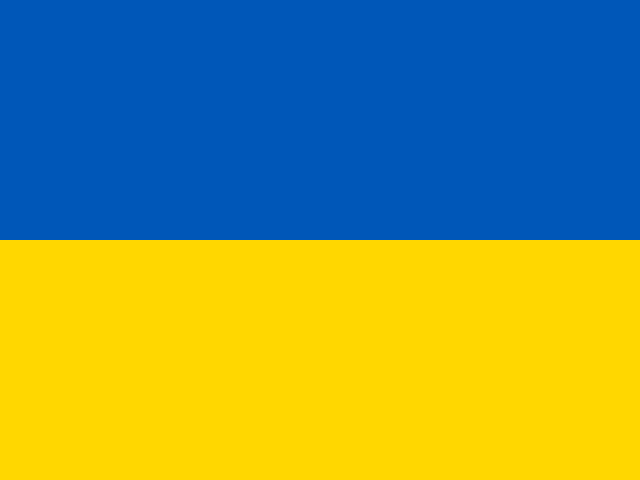
Two horizontal bands, blue on top and yellow below. The usual reading is blue sky over a yellow wheat field, which suits a country famous for its grain. The flag dates from the nineteenth century and was readopted when Ukraine became independent in 1991.
There are not many two-band flags to confuse it with. Monaco and Indonesia are red over white, Poland is white over red, and Ukraine is the only blue-over-yellow one among UN members. If you see those two colours in that order, it is Ukraine.
A short history of Ukraine
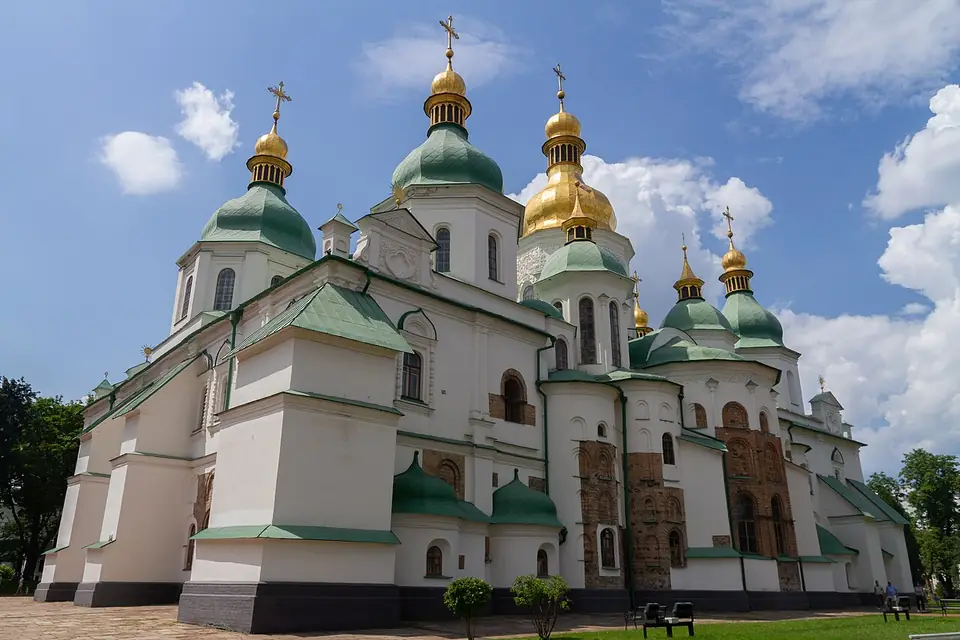
The steppe north of the Black Sea has drawn settlers and invaders for thousands of years. Farmers of the Trypillia culture built large villages here over 5,000 years ago, Scythian horsemen later roamed the grasslands, and Greek colonists founded trading towns along the coast and in Crimea. In the 800s a state known as Kyivan Rus' grew up around Kyiv. Its ruler Volodymyr adopted Orthodox Christianity in 988, and his son Yaroslav the Wise built the Cathedral of St Sophia. Ukrainians, Belarusians and Russians all trace their roots to this medieval state.
Mongol armies sacked Kyiv in 1240, and most Ukrainian lands later fell under Lithuania and then Poland. On the lawless southern frontier, runaway peasants formed the Cossacks, free warrior communities centred on the Zaporizhian Sich on the Dnipro's islands. In 1648 the Cossack leader Bohdan Khmelnytsky rose against Poland and then turned to Moscow for support. Over the next 150 years most of Ukraine was absorbed into the Russian Empire, which also took Crimea from the Crimean Khanate in 1783. The far west, Galicia, went to Austria – one reason western Ukraine still feels different from the east.
After the 1917 revolutions Ukraine briefly declared independence, but it became part of the Soviet Union. Stalin's forced collectivisation caused the Holodomor, a famine in 1932–33 that killed millions; Ukraine and many other countries regard it as a genocide. The Second World War brought enormous destruction, including the massacre of Kyiv's Jews at Babyn Yar in 1941. In 1954 Crimea was transferred from Soviet Russia to Soviet Ukraine.
In the 1991 referendum more than 90 per cent voted for independence. Protests in 2004, the Orange Revolution, and in 2013–14, known as Euromaidan, showed a growing pull towards Europe. In 2014 Russia annexed Crimea; Russia considers it Russian territory, while Ukraine and most other countries regard it as Ukrainian land under occupation. Fighting also began in the eastern Donbas region, years before the full-scale war. Ukraine became an EU candidate country in 2022 and remains a major exporter of grain and steel, with a fast-growing IT sector.
Culture and daily life in Ukraine
Ukrainian is an East Slavic language written in Cyrillic, related to but distinct from Russian and Polish. Centuries of Russian rule meant many people, especially in the east and south, grew up speaking Russian, and the language question has become closely tied to national identity. Most believers are Orthodox, while the west has a large Greek Catholic church that follows Eastern rites but recognises the Pope.
The national poet is Taras Shevchenko, a former serf whose 1840 collection Kobzar became a founding text of Ukrainian literature; Lesya Ukrainka is another literary icon. Nikolai Gogol, born in Ukraine, wrote his famous stories in Russian. Wandering minstrels called kobzars once sang epics while playing the many-stringed bandura. The tune of "Carol of the Bells" comes from Shchedryk, a Ukrainian folk song arranged by Mykola Leontovych.
The energetic hopak dance comes from Cossack tradition, and Petrykivka decorative painting is listed by UNESCO. Ukraine has won Eurovision three times, and sporting heroes include footballer Andriy Shevchenko and pole vaulter Serhiy Bubka.
Five facts worth knowing
- Ukraine is the largest country entirely in Europe at over 600,000 square kilometres – bigger than France.
- The Dnipro is one of Europe's longest rivers, rising in Russia and flowing through Belarus and down the length of Ukraine to the Black Sea. Kyiv sits on its banks.
- Ukraine's "black earth" (chernozem) soils are among the most fertile in the world, which is why the country has long been a major exporter of wheat, sunflower oil and maize.
- Chernobyl, site of the 1986 nuclear accident, is in northern Ukraine near the border with Belarus.
- Ukraine became independent in 1991 when the Soviet Union broke up; Russia's invasion in 2022 is the reason the country is now so often in the news.
Culture and traditions in Ukraine
- Saying hello
A handshake with "Dobryi den" (good day), or "Pryvit" (hi) between friends.
- Food and drink
Borscht, a beet soup that is UNESCO-listed; varenyky, dumplings filled with potato, cheese or cherries.
- Festivals and traditions
Ivana Kupala midsummer night (6–7 July), with flower wreaths and bonfires; decorated Easter eggs (pysanky).
- Everyday life
Shoes come off at home. When giving flowers, people choose an odd number, as even numbers are for funerals.
- Did you know?
Vyshyvanka Day, held on the third Thursday of May, celebrates the traditional embroidered shirt.
Common mistakes
- Tapping Belarus – the landlocked country directly north.
- Tapping Romania or Moldova, which sit on Ukraine's south-western edge and share its Black Sea corner.
- Forgetting that Crimea is part of the Ukraine outline on the map, even though Russia has occupied it since 2014.
- Confusing the flag with Sweden's colours – Sweden is blue with a yellow cross, not two bands.
Practise with Ukraine
- Europe quiz – the big country on the north shore of the Black Sea, east of Poland.
- Europe flags – blue over yellow, nothing else on it.
- Europe capitals quiz – Kyiv.
- Mystery Country – the wide oval with the Crimean peninsula hanging off the bottom.
- Mistake Bank – if you keep swapping Ukraine and Belarus, this is where to drill them.
Nearby countries
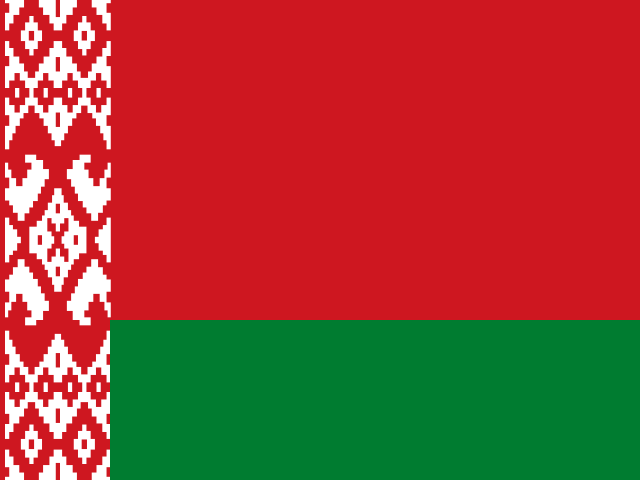 BelarusMinsk
 HungaryBudapest
 MoldovaChișinău
 PolandWarsaw
 RomaniaBucharest
 RussiaMoscow
 SlovakiaBratislava
Quick check: how well do you know Ukraine?
3 questions, no sign-up. Tap an answer.
1. Which flag belongs to Ukraine?
That's the flag of Ukraine.
2. What is the capital of Ukraine?
The capital of Ukraine is Kyiv.
3. Which of these countries borders Ukraine?
Belarus, Hungary, Moldova, Poland, Romania, Russia and Slovakia border Ukraine.
Keep going on the Europe quiz – Ukraine is one of 46 countries there.
More ways to practise: find Ukraine on the blank map with no borders (hard mode), or play today's Globe and the other daily puzzles.
Frequently asked questions about Ukraine
What language is spoken in Ukraine?
Ukrainian is the sole official language and is written in the Cyrillic alphabet. Russian has long been widely spoken, especially in the east and south, though many people have switched to Ukrainian since 2014. Crimean Tatar, Hungarian and Romanian are spoken by minorities.
What currency does Ukraine use?
Ukraine uses the hryvnia (UAH), introduced in 1996 and divided into 100 kopiyok. The name goes back to a unit of silver used in medieval Kyivan Rus. Since 2023 the National Bank has let it float within managed limits.
What time zone is Ukraine in?
Ukraine is on Eastern European Time, UTC+2, and moves to UTC+3 for daylight saving time from late March to late October. Areas under Russian occupation have been switched to Moscow time.
Which side of the road do they drive on in Ukraine?
Ukraine drives on the right, like all its neighbours. Its road network is the main overland link to Poland, Romania and Moldova, and long queues of lorries at the western border crossings are common.
What is the highest point in Ukraine?
The highest point is Hoverla, at about 2,060 metres, in the Carpathian Mountains in the west. Climbing it is a popular summer tradition, and the summit has a cross and a Ukrainian flag.
What is Ukraine known for?
Ukraine is known as one of the world's great grain exporters, thanks to its fertile black earth, or chornozem. It is also known for borscht, the decorated Easter eggs called pysanky, and the 1986 Chernobyl nuclear disaster, which took place in the north of the country.
Quizzes with Ukraine
Often confused with
Guides that help with this
- All 46 European capitals, with a memory trick for eachCapitals grouped by region, with hooks for the ones people forget.
- Flags that look alike (and how to tell them apart)Chad or Romania? Australia or New Zealand? The flag pairs that cost quiz points.
- The 25 hardest countries to find on a mapPacific islands, Caribbean islands and landlocked Africa – where they are.