Bosnia and Herzegovina
Capital: Sarajevo. Bosnia and Herzegovina is one of the 46 countries in the Europe quiz.
Quick answers: What is the capital of Bosnia and Herzegovina? · Which countries border Bosnia and Herzegovina?
Facts about Bosnia and Herzegovina
- CapitalSarajevo
- Population3.1 million
- Area51,209 km²
- RegionsEurope, The Balkans
- LanguagesBosnian, Croatian, Serbian
- CurrencyBosnia and Herzegovina convertible mark (BAM)
Bosnia and Herzegovina is the 28th most populous of the 46 countries in Europe and the 26th largest by area. Worldwide it ranks 134th by population and 125th by area.
Where is Bosnia and Herzegovina?
Bosnia and Herzegovina is in the western Balkans, in south-eastern Europe. Croatia wraps around it to the north, west and south, Serbia lies to the east and Montenegro to the south-east. It has a tiny coastline on the Adriatic at Neum, just 20 km long, which cuts Croatia's Dalmatian coast in two. Sarajevo, the capital, is in the centre-east of the country. Bosnia is the larger northern part; Herzegovina is the smaller southern region around Mostar.
On a world map, find Croatia's distinctive boomerang shape on the Adriatic. Bosnia and Herzegovina fills the inside of the boomerang.
How to find Bosnia and Herzegovina on the map
- Start from Croatia. Bosnia and Herzegovina is the country sitting inside the curve of Croatia.
- Look for the triangle. At Europe-map zoom it is roughly triangular, with the point facing south towards the Adriatic.
- Find the Neum gap. The tiny break in Croatia's coastline is where Bosnia reaches the sea.
- Don't confuse it with Serbia. Serbia is east of Bosnia and fully landlocked; Bosnia is the one inside Croatia's curve.
Flag
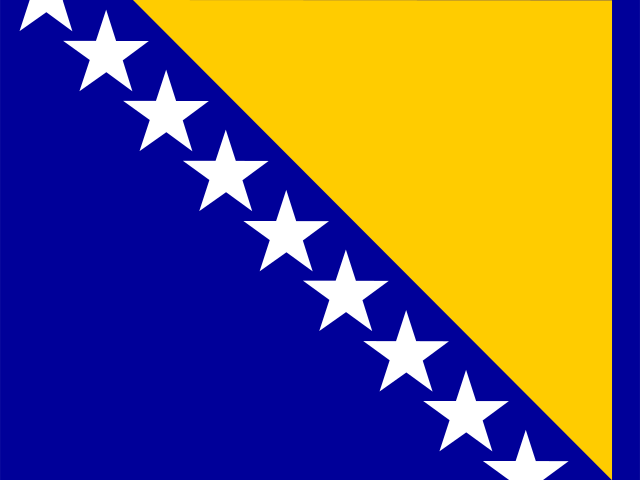
The flag is a blue field with a yellow right-angled triangle and a diagonal row of white stars along its long side. The three corners represent the country's three main peoples – Bosniaks, Croats and Serbs – and the colours echo the EU flag. It was adopted in 1998 because the communities could not agree on a traditional design.
In the Flags quiz, a yellow triangle with a line of white stars on blue is unique.
A short history of Bosnia and Herzegovina
In Roman times this mountainous land belonged to the province of Illyricum, later Dalmatia. Slavic peoples settled here in the 6th and 7th centuries, and by the Middle Ages a Bosnian state had emerged between the rival powers of Hungary and Byzantium. It reached its peak under Tvrtko I, who was crowned king in 1377. Medieval Bosnia also had its own Christian community, the Bosnian Church, which neither Rome nor the Orthodox world fully accepted.
The Ottoman Turks conquered Bosnia in 1463, and Herzegovina followed about twenty years later. Four centuries of Ottoman rule changed the country deeply. Many Bosnians converted to Islam, towns such as Sarajevo and Mostar grew around mosques, markets and bridges, and Sephardic Jews expelled from Spain found a home here.
In 1878 Austria-Hungary took over the administration, and in 1908 it annexed the territory outright, angering neighbouring Serbia. After the First World War Bosnia became part of the new Kingdom of Serbs, Croats and Slovenes, later called Yugoslavia. During the Second World War it was absorbed into a Nazi-backed Croatian puppet state, and much of the fighting between Tito's Partisans and their enemies took place in its forests and mountains. After 1945 it became one of the six republics of socialist Yugoslavia.
When Yugoslavia broke apart, Bosnia and Herzegovina held an independence referendum in 1992. Bosnian Serb leaders rejected it, and war followed. Sarajevo was besieged for almost four years, and in July 1995 Bosnian Serb forces killed around 8,000 Bosniak men and boys at Srebrenica, a massacre international courts have ruled was genocide. Millions of people were displaced, and the ethnic map of the country changed sharply.
Since the war the country has rebuilt slowly. Power is shared between its communities, which makes decisions hard to reach. It is now an official candidate for European Union membership, and tourism to Sarajevo, Mostar and the mountains has grown steadily.
Culture and daily life in Bosnia and Herzegovina
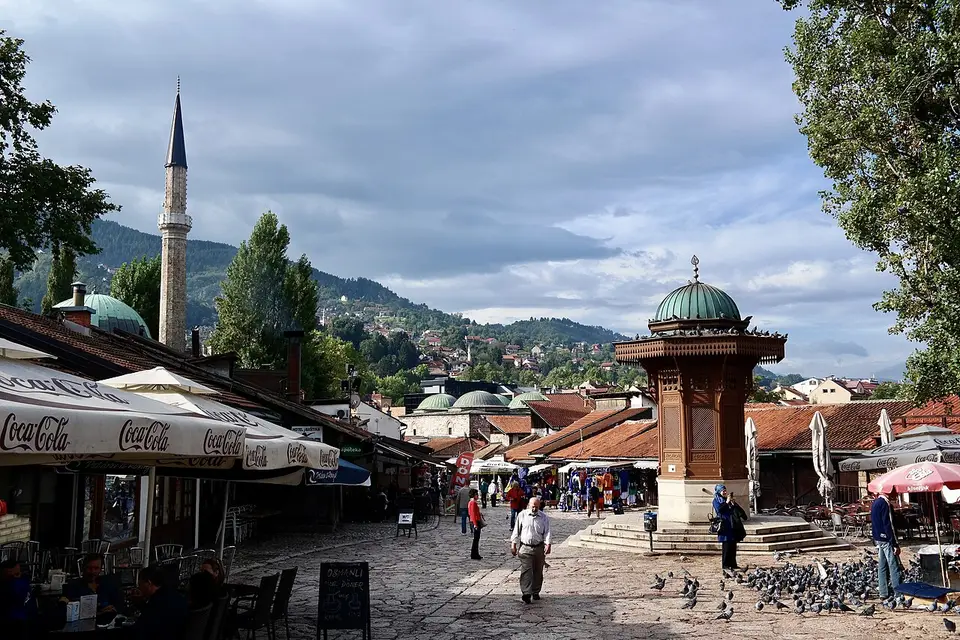
Bosnian, Croatian and Serbian are so close that people understand each other easily, yet each community treats its own as a separate language. Both Latin and Cyrillic letters are used. In Sarajevo, a mosque, an Orthodox church, a Catholic cathedral and a synagogue stand within a short walk of one another, which is why the city is often called the "Jerusalem of Europe". The old Ottoman bazaar, Baščaršija, is still its heart.
The country's best-known writer is Ivo Andrić, who won the Nobel Prize in Literature in 1961. His novel The Bridge on the Drina tells four centuries of history through the Ottoman bridge at Višegrad, now a UNESCO site. Also listed by UNESCO are the stećci, carved medieval tombstones scattered across the hills. Bosnian film gained a world audience when Danis Tanović's No Man's Land won the Oscar for best foreign-language film.
The traditional song form is sevdalinka, slow and full of longing, with roots in Ottoman times. Football is the most popular sport, and striker Edin Džeko became a national hero.
Five facts worth knowing
- The assassination of Archduke Franz Ferdinand in Sarajevo in 1914 triggered the First World War.
- Sarajevo hosted the Winter Olympics in 1984, the first held in a communist country.
- The Bosnian War of 1992–1995 followed the break-up of Yugoslavia; the Dayton Agreement that ended it still shapes the country's complex political system.
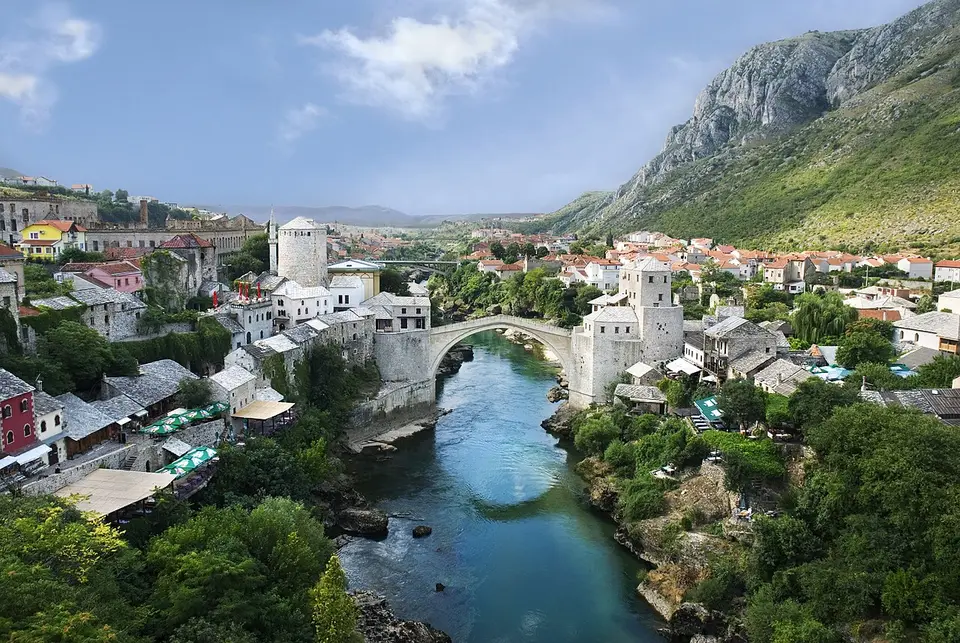
- The Stari Most (Old Bridge) in Mostar, built by the Ottomans in the 16th century, was destroyed in 1993 and rebuilt in 2004.
- The country is divided into two entities – the Federation of Bosnia and Herzegovina and Republika Srpska – plus the small Brčko District.
Culture and traditions in Bosnia and Herzegovina
- Saying hello
A handshake and "Zdravo"; friends kiss three times on the cheeks.
- Food and drink
Cevapi (grilled minced meat in flatbread) and burek, a meat-filled pastry.
- Festivals and traditions
The Sarajevo Film Festival in August, one of the largest in the region.
- Everyday life
Bosnian coffee, brewed in a copper dzezva and served with a sugar cube, is a slow social ritual.
- Did you know?
Divers have jumped from the Old Bridge in Mostar for centuries, and the tradition continues every summer.
Common mistakes
- Tapping Croatia, which wraps around it on three sides.
- Tapping Serbia or Montenegro to the east and south-east.
- Missing the Neum coastline and assuming the country is landlocked.
Practise with Bosnia and Herzegovina
- Balkans quiz – the zoomed-in map where the former Yugoslav countries are easy to separate.
- Europe quiz – the triangle inside Croatia's curve.
- Europe flags – blue with a yellow triangle and white stars.
- Europe capitals quiz – Sarajevo.
- Mystery Country – a near-triangular outline with a tiny notch on the southern tip.
Nearby countries
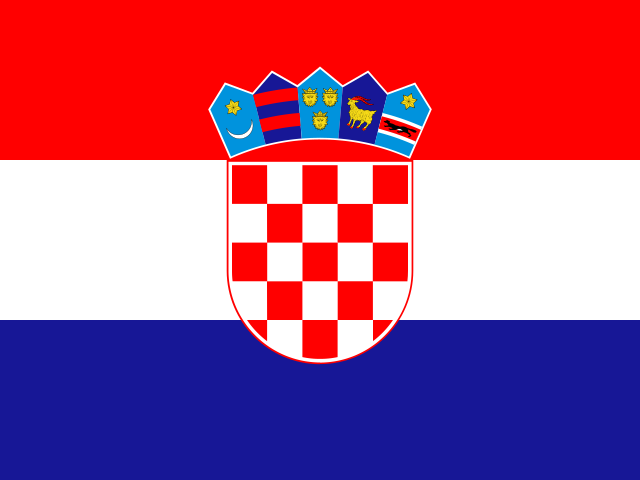 CroatiaZagreb
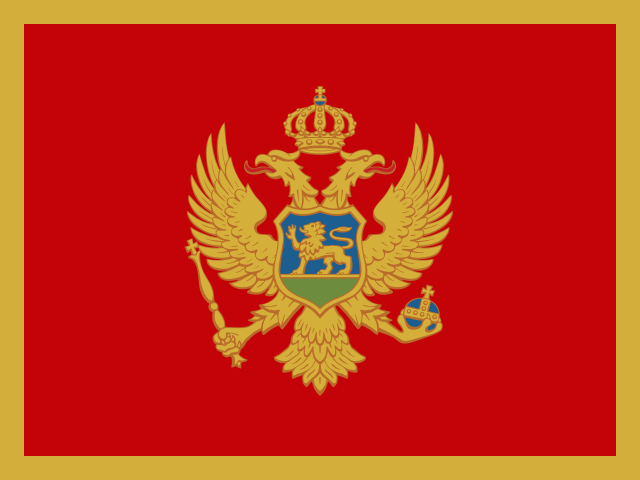 MontenegroPodgorica
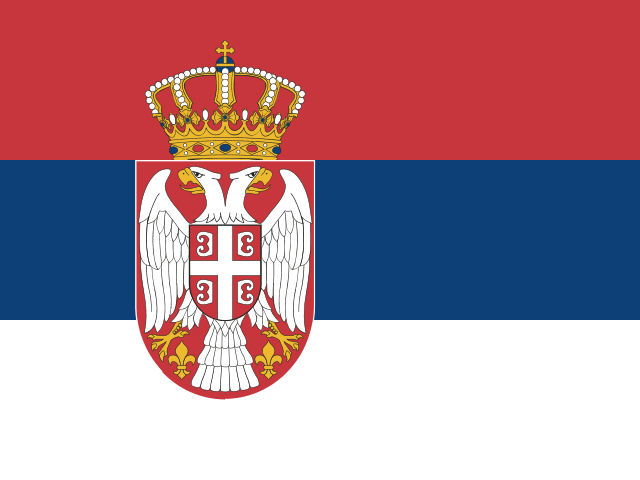 SerbiaBelgrade
Quick check: how well do you know Bosnia and Herzegovina?
3 questions, no sign-up. Tap an answer.
1. Which flag belongs to Bosnia and Herzegovina?
That's the flag of Bosnia and Herzegovina.
2. What is the capital of Bosnia and Herzegovina?
The capital of Bosnia and Herzegovina is Sarajevo.
3. Which of these countries borders Bosnia and Herzegovina?
Croatia, Montenegro and Serbia border Bosnia and Herzegovina.
Keep going on the Europe quiz – Bosnia and Herzegovina is one of 46 countries there.
More ways to practise: find Bosnia and Herzegovina on the blank map with no borders (hard mode), or play today's Globe and the other daily puzzles.
Frequently asked questions about Bosnia and Herzegovina
What language is spoken in Bosnia and Herzegovina?
Bosnian, Croatian and Serbian are all official. They are standard forms of the same language and are mutually intelligible, though each community uses its own name. Bosnian and Croatian use the Latin alphabet, while Serbian uses both Cyrillic and Latin.
What currency does Bosnia and Herzegovina use?
The country uses the convertible mark (BAM), introduced in 1998. It was originally pegged one-to-one to the German mark and is now fixed to the euro at the same rate, about 1.956 marks per euro.
What time zone is Bosnia and Herzegovina in?
Bosnia and Herzegovina uses Central European Time, UTC+1, and moves to UTC+2 for daylight saving time in summer, like its neighbours Croatia, Serbia and Montenegro.
Which side of the road do they drive on in Bosnia and Herzegovina?
Traffic drives on the right. The country has only a short motorway network, and many main roads follow river valleys through the mountains, such as the Neretva valley between Sarajevo and Mostar.
What is the highest point in Bosnia and Herzegovina?
The highest point is Maglić, about 2,386 metres, on the border with Montenegro in the south-east. It rises above Sutjeska National Park, one of the last remnants of primeval forest in Europe at Perućica.
Is Bosnia and Herzegovina in the EU?
No. Bosnia and Herzegovina is not an EU member, but it applied in 2016 and was granted candidate status in December 2022. It is also not in NATO, although it takes part in NATO's partnership programmes.
Quizzes with Bosnia and Herzegovina
Guides that help with this
- All 46 European capitals, with a memory trick for eachCapitals grouped by region, with hooks for the ones people forget.
- Flags that look alike (and how to tell them apart)Chad or Romania? Australia or New Zealand? The flag pairs that cost quiz points.
- The 25 hardest countries to find on a mapPacific islands, Caribbean islands and landlocked Africa – where they are.