Rwanda
Capital: Kigali. Rwanda is one of the 54 countries in the Africa quiz.
Quick answers: What is the capital of Rwanda? · Which countries border Rwanda?
Facts about Rwanda
- CapitalKigali
- Population14.6 million
- Area26,338 km²
- RegionsAfrica, East Africa
- LanguagesKinyarwanda, English, French
- CurrencyRwandan franc (RWF)
Rwanda is the 29th most populous of the 54 countries in Africa and the 46th largest by area. Worldwide it ranks 77th by population and 145th by area.
Where is Rwanda?
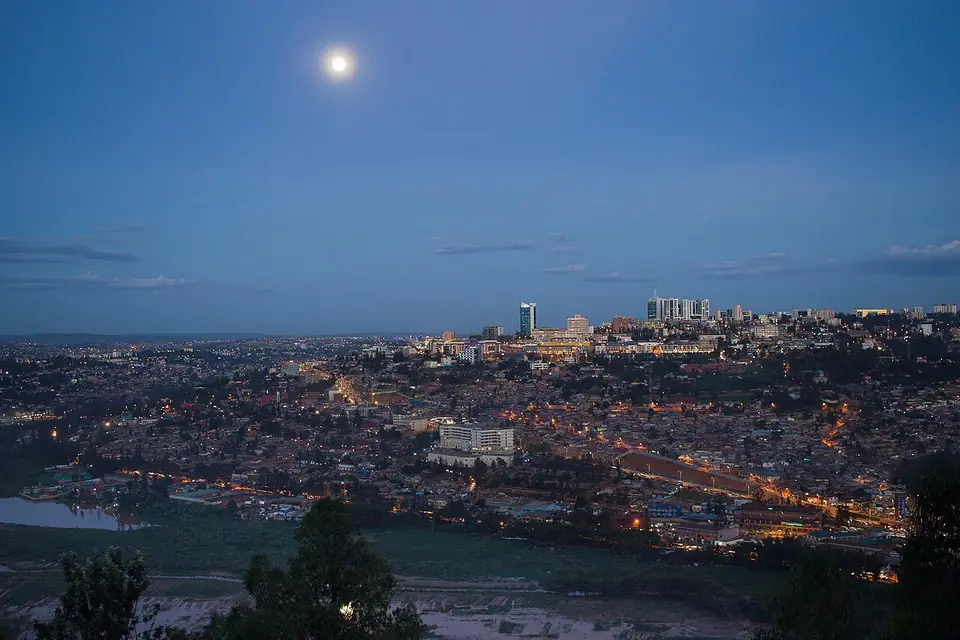
Rwanda is a small, hilly, landlocked country in East Africa, just south of the equator in the Great Lakes region. It borders Uganda to the north, Tanzania to the east, Burundi to the south and the Democratic Republic of the Congo to the west, where Lake Kivu forms most of the border. Kigali, the capital, sits in the centre of the country.
On a world map, find Lake Victoria. Rwanda is the small country just to its west, tucked between Uganda and Tanzania, with Burundi immediately below it.
How to find Rwanda on the map
- Start from Lake Victoria. Rwanda is the small country a little west of the lake's western shore.
- Find the pair. Rwanda and Burundi are two similarly sized countries stacked on top of each other; Rwanda is the northern one.
- Look for Lake Kivu. The long lake on Rwanda's western edge separates it from the DR Congo.
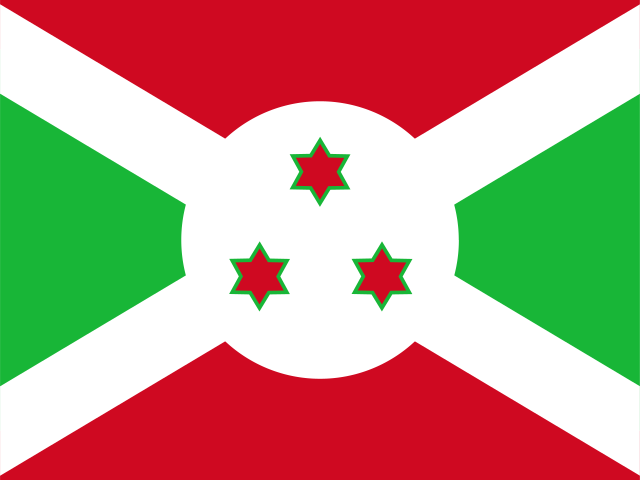
- Don't confuse it with Burundi. Burundi is the southern twin and touches Lake Tanganyika; Rwanda touches Lake Kivu.
Flag
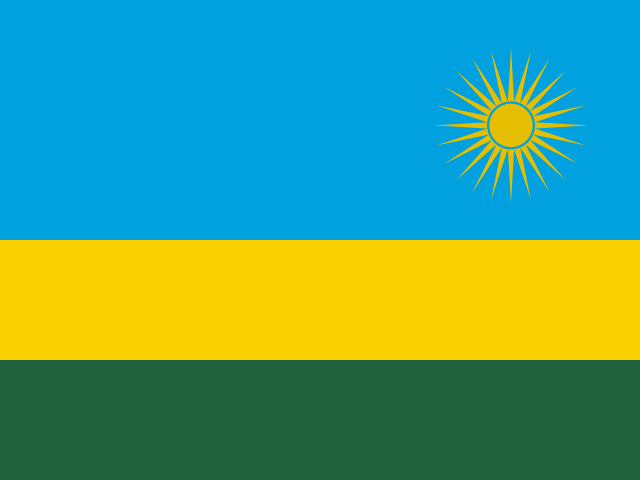
Rwanda's flag has three horizontal bands: a wide light blue band on top, then yellow and green bands of equal height below it. In the top-right corner of the blue band is a golden sun with 24 rays. It was adopted in 2001 to replace the old red-yellow-green flag.
The blue-yellow-green combination is unusual in Africa. Gabon is green-yellow-blue with no sun. If blue is on top and there's a sun in the corner, it's Rwanda.
A short history of Rwanda
The hills of Rwanda were settled long ago by the Twa, forest hunters, and later by farmers and cattle herders who all came to share the same language, Kinyarwanda. Over time, society divided into groups called Hutu, Tutsi and Twa. These labels were linked to occupation and wealth – cattle-owning Tutsi tended to hold power – and people could sometimes move between them.
From around the 1500s, the Kingdom of Rwanda grew under a line of kings, or mwami, who were usually Tutsi. By the 1800s, it was one of the most centralised states in the Great Lakes region, with an army, chiefs and a royal court. Its strength kept slave traders out, and the kingdom expanded west towards Lake Kivu.
Germany claimed Rwanda in the 1890s and ruled through the king. After the First World War, Belgium took over Rwanda and neighbouring Burundi as Ruanda-Urundi. The Belgians favoured the Tutsi elite and, in the 1930s, introduced identity cards stating each person's group. This turned flexible categories into fixed ethnic labels and deepened resentment.
In 1959 a Hutu uprising began a revolution that abolished the monarchy by 1961, and many thousands of Tutsi fled to neighbouring countries. Rwanda became independent in 1962 under a Hutu-led government. Violence against Tutsi broke out several times. In 1990, the Rwandan Patriotic Front, a rebel army formed mostly by Tutsi exiles in Uganda, invaded. In April 1994, after the president's plane was shot down, extremists launched the genocide against the Tutsi, also killing moderate Hutu. The RPF took Kigali and ended the killing in July. Afterwards, millions of Hutu fled into what is now the Democratic Republic of the Congo, which helped trigger wars there.
Since then, Rwanda has rebuilt itself with a strong central government. Ethnic labels were removed from identity cards, and the country has become known for clean streets, fast-growing services, tourism and coffee and tea exports, though critics point to tight limits on political opposition.
Culture and daily life in Rwanda
Almost everyone speaks Kinyarwanda, which gives Rwanda an unusually shared language for an African country. French and English are both official; English spread after 1994, when many returning exiles had grown up in English-speaking Uganda and Tanzania. Most people are Christian, mainly Catholic or Protestant, with a small Muslim minority.
Traditional dance is a point of pride. The intore, or "chosen ones", perform warrior dances with grass headdresses, spears and shields to pounding drums. Imigongo, a craft from the east, uses cow dung to create bold black, red and white geometric patterns on panels. The King's Palace Museum at Nyanza shows a rebuilt royal hut and the long-horned Inyambo cattle.
Memory of 1994 shapes national life: gacaca community courts, based on an old tradition, were revived to judge genocide cases, and every April begins Kwibuka, a period of remembrance. Cycling has become a popular sport, and the Tour du Rwanda race draws crowds along the hilly roads. Rwandan coffee and tea are grown on the steep hillsides.
Five facts worth knowing
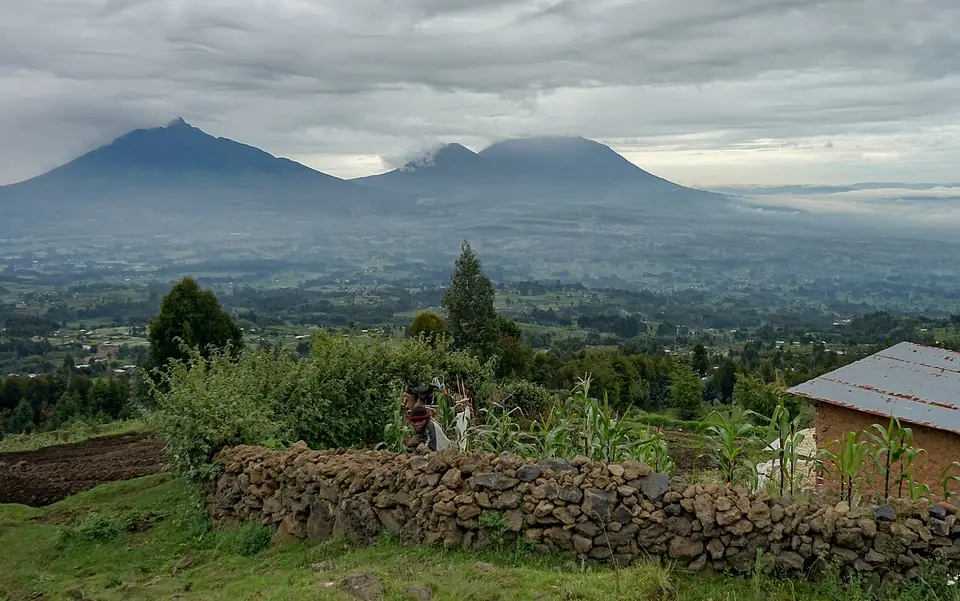
- Rwanda is known as "the land of a thousand hills" – almost the whole country is above 1,000 metres and the terrain is relentlessly rolling.
- The 1994 genocide killed around 800,000 people in about 100 days; the Kigali Genocide Memorial is the main site of remembrance.
- Rwanda's parliament has one of the highest proportions of women of any in the world, with women holding a majority of seats in the lower house.
- Volcanoes National Park in the north-west is one of the few places on Earth where mountain gorillas can be seen in the wild.
- Rwanda is a member of the Commonwealth despite having been a Belgian, not British, colony; it joined in 2009 and hosted the Commonwealth summit in 2022.
Culture and traditions in Rwanda
- Saying hello
A handshake or a hug; "Muraho" in Kinyarwanda.
- Food and drink
Isombe, cassava leaves with eggplant and spinach, and brochettes, grilled meat skewers.
- Festivals and traditions
Umuganura, the harvest festival, on the first Friday of August; Kwita Izina, the gorilla-naming ceremony, in September.
- Everyday life
Umuganda, a monthly community work day on the last Saturday, is a national tradition. Plastic bags are banned.
- Did you know?
Rwanda has one of the world's highest shares of women in parliament.
Common mistakes
- Tapping Burundi – the most common slip; remember Rwanda is the one on top.
- Tapping Uganda, the larger neighbour to the north.
- Confusing Lake Kivu with Lake Tanganyika and so landing in the wrong country.
Practise with Rwanda
- Africa quiz – a small target west of Lake Victoria; find Uganda first and look just below it.
- East Africa quiz – a regional map where the Rwanda / Burundi pair is easy to study.
- Africa flags – blue, yellow and green with a sun in the corner.
- Africa capitals quiz – Kigali.
- Mystery Country – a compact, rounded outline with a long lake-shaped bite on the western side.
Nearby countries
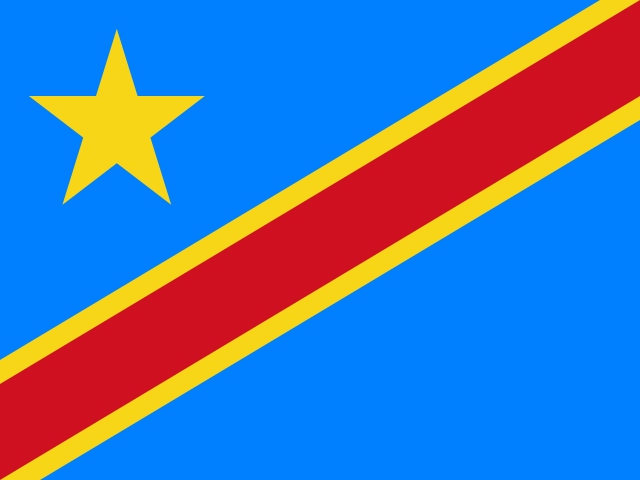
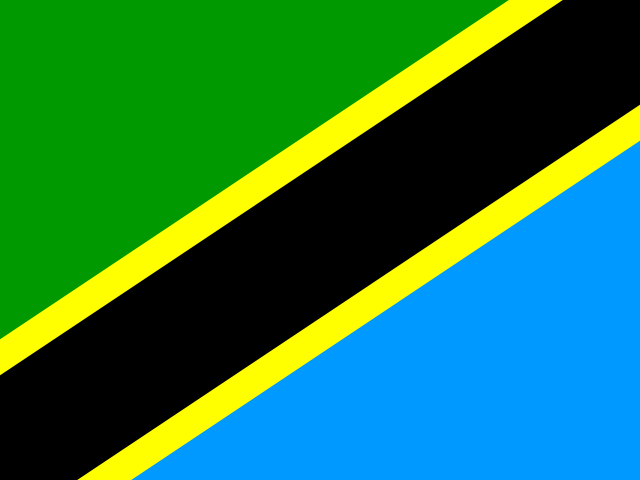
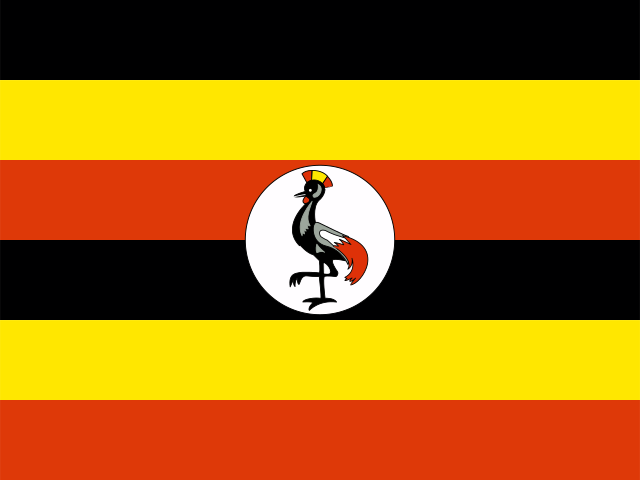
Quick check: how well do you know Rwanda?
3 questions, no sign-up. Tap an answer.
1. Which flag belongs to Rwanda?
That's the flag of Rwanda.
2. What is the capital of Rwanda?
The capital of Rwanda is Kigali.
3. Which of these countries borders Rwanda?
Burundi, DR Congo, Tanzania and Uganda border Rwanda.
Keep going on the Africa quiz – Rwanda is one of 54 countries there.
More ways to practise: find Rwanda on the blank map with no borders (hard mode), or play today's Globe and the other daily puzzles.
Frequently asked questions about Rwanda
What language is spoken in Rwanda?
Kinyarwanda, English and French are official languages, and Kinyarwanda is the mother tongue of almost every Rwandan. English largely replaced French in schools from 2008. Swahili, given official status in 2017, is widely used in trade with East African neighbours.
What currency does Rwanda use?
Rwanda uses the Rwandan franc, code RWF. It is the country's own currency, issued by the National Bank of Rwanda, and is not pegged to the euro or the dollar. Mobile money is widely used for everyday payments.
What time zone is Rwanda in?
Rwanda uses Central Africa Time, UTC+2, the same as Burundi and eastern DR Congo. Being so close to the equator, it has no daylight saving time, and sunrise and sunset come at almost the same hour all year.
Which side of the road do they drive on in Rwanda?
Rwanda drives on the right, a legacy of Belgian rule. This sets it apart from its East African neighbours Uganda, Kenya and Tanzania, which drive on the left, so drivers crossing those borders must switch sides.
What is the highest point in Rwanda?
Mount Karisimbi, a dormant volcano in the Virunga range on the border with DR Congo, is the highest point at about 4,507 metres. Its upper slopes are sometimes dusted with hail and frost despite lying just south of the equator.
What is Lake Kivu?
Lake Kivu, on Rwanda's western border with DR Congo, is one of the African Great Lakes. Its deep waters hold huge amounts of dissolved methane and carbon dioxide, and Rwanda extracts some of the methane to generate electricity.
Quizzes with Rwanda
Often confused with
Guides that help with this
- Learn all 54 African countries in a weekLearn the coastline in order, region by region.
- Flags that look alike (and how to tell them apart)Chad or Romania? Australia or New Zealand? The flag pairs that cost quiz points.
- The 25 hardest countries to find on a mapPacific islands, Caribbean islands and landlocked Africa – where they are.