Uzbekistan
Capital: Tashkent. Uzbekistan is one of the 48 countries in the Asia quiz.
Quick answers: What is the capital of Uzbekistan? · Which countries border Uzbekistan?
Facts about Uzbekistan
- CapitalTashkent
- Population37.1 million
- Area447,400 km²
- RegionsAsia, Central & South Asia
- LanguageUzbek
- CurrencyUzbekistani som (UZS)
Uzbekistan is the 17th most populous of the 48 countries in Asia and the 15th largest by area. Worldwide it ranks 42nd by population and 56th by area.
Where is Uzbekistan?
Uzbekistan is in the heart of Central Asia, surrounded by the other four Central Asian republics and Afghanistan. Kazakhstan lies to the north, Kyrgyzstan and Tajikistan to the east, Afghanistan to the south and Turkmenistan to the south-west. The shrunken Aral Sea sits on its northern border with Kazakhstan. The capital, Tashkent, is in the far east of the country, close to the Kazakh border.
On a world map, find the Caspian Sea, then move east past Turkmenistan. Uzbekistan is the next country, stretching from the Aral Sea in the north-west towards the mountains in the east.
How to find Uzbekistan on the map
- Start from Kazakhstan. Uzbekistan is the country directly south of Kazakhstan's central section.
- Look for the Aral Sea. What remains of the lake lies on the Uzbek–Kazakh border; Uzbekistan is the southern side.
- Find the one in the middle. It is the only Central Asian country that touches all four of the others.
- Don't confuse it with Turkmenistan. Turkmenistan reaches the Caspian Sea; Uzbekistan does not, and it is the larger and more populous of the two.
Flag
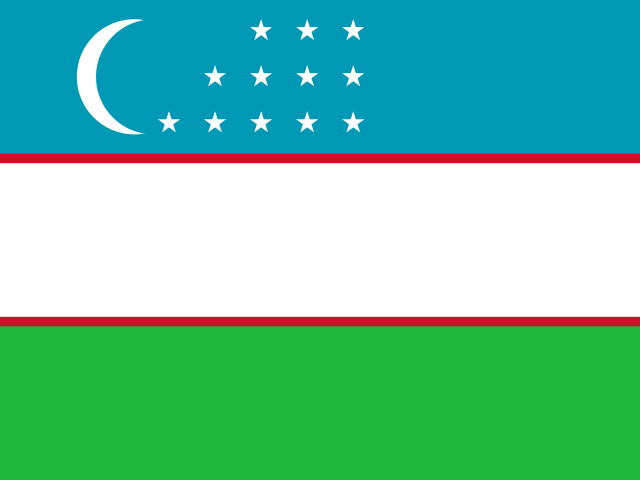
Uzbekistan's flag has three horizontal bands of blue, white and green, separated by thin red stripes. In the upper hoist corner of the blue band is a white crescent with twelve white stars arranged in three rows. Blue recalls the banner of Timur, white stands for peace, green for nature and the twelve stars for the months of the year.
In the Flags quiz, the thin red fimbriations between the bands are the detail to look for. Sierra Leone's green-white-blue is the reverse order and has no crescent.
A short history of Uzbekistan
The rivers Amu Darya and Syr Darya turned this dry land into a cradle of cities. In ancient times the regions of Sogdiana and Khorezm grew rich on farming and trade; the Sogdians became the great merchants of the Silk Road, carrying goods and ideas between China and Persia. Alexander the Great fought here in the 320s BC and married a local princess, Roxana. Arab armies arrived in the early 700s, and Islam replaced older faiths such as Zoroastrianism and Buddhism.
Under the Persian Samanid dynasty in the 800s and 900s, Bukhara became a centre of learning. The region produced towering scholars: al-Khwarizmi, whose name gave us the word "algorithm", and Ibn Sina (Avicenna), whose medical textbook was used in Europe for centuries. Then, in 1220, Genghis Khan's Mongols destroyed Bukhara and Samarkand. A century and a half later, Timur rebuilt Samarkand as the capital of a vast empire, and his grandson Ulugh Beg built a famous observatory there in the 1420s.
Around 1500 the Uzbeks, Turkic-speaking nomads from the north, conquered the region and gave it their name. It later split into three states – the khanates of Khiva and Kokand and the Emirate of Bukhara. Russia conquered them between the 1860s and 1870s, taking Tashkent in 1865 and making it the centre of Russian Turkestan.
In 1924 Soviet planners drew new national borders and created the Uzbek SSR. The lines divided mixed communities, which is why the fertile Fergana Valley is now split between Uzbekistan, Kyrgyzstan and Tajikistan in a tangle of borders and enclaves. The Soviets turned the republic into a giant cotton farm. In 1966 an earthquake destroyed much of old Tashkent, and the city was rebuilt in Soviet style.
Uzbekistan became independent in 1991 and was tightly controlled for 25 years. Since 2016 it has opened up to tourism and foreign trade. Its economy relies on natural gas, gold, cotton and money sent home by workers abroad.
Culture and daily life in Uzbekistan
Uzbek is a Turkic language; in Soviet times it switched from Arabic script to Latin and then to Cyrillic, and it is now changing back to a Latin alphabet. Russian is still widely understood in cities. In Bukhara and Samarkand many people speak Tajik, a form of Persian, showing how the two cultures have mixed for centuries. Most Uzbeks are Sunni Muslims, though Soviet rule left society fairly secular.
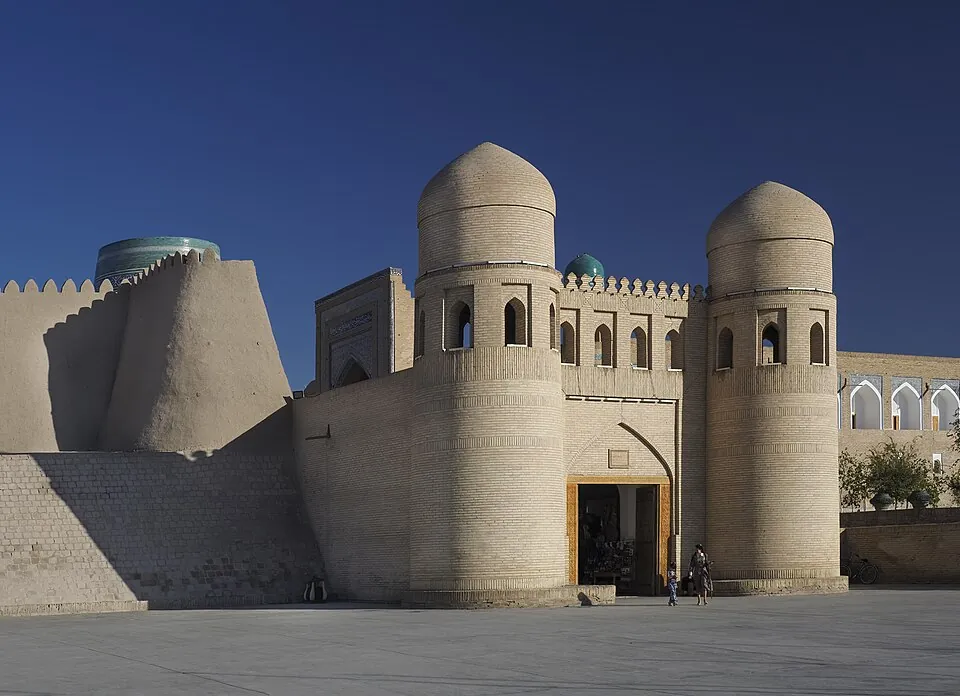
The national poet is Alisher Navoi, who wrote in the 15th century and helped make the Turkic language a literary one. Classical music called Shashmaqam, performed with long-necked lutes and frame drums, is shared with Tajikistan. In architecture, Khiva's walled inner city, Itchan Kala, looks like a living museum.
Craft traditions are rich: silk weaving with bright ikat patterns, embroidered suzani wall hangings and blue ceramics from Rishton. Each neighbourhood, or mahalla, works like a small community that helps with weddings and funerals. Kurash, a traditional wrestling style, is a national sport, and the country has become a strong force in boxing.
Five facts worth knowing
- It is one of only two doubly landlocked countries in the world – landlocked and surrounded entirely by other landlocked countries. The other is Liechtenstein.
- Samarkand and Bukhara were great cities of the Silk Road, and both are UNESCO World Heritage Sites known for their blue-tiled mosques and madrasas.
- The Aral Sea has lost most of its water since the 1960s because the rivers feeding it were diverted for cotton irrigation, leaving ships stranded in the desert near Moynaq.
- It is the most populous country in Central Asia, with more people than Kazakhstan, Kyrgyzstan and Turkmenistan combined.
- Timur, the fourteenth-century conqueror, was born near Samarkand and is a national hero; his mausoleum, the Gur-e-Amir, stands in the city.
Culture and traditions in Uzbekistan
- Saying hello
A handshake with the right hand on the heart and "Assalomu alaykum".
- Food and drink
Plov, rice with lamb and carrots, whose tradition is UNESCO-listed; non, round flatbread; green tea.
- Festivals and traditions
Navruz, the spring New Year, around 21 March, with sumalak pudding and celebrations.
- Everyday life
Hosts pour tea only part way to show they will keep refilling it. Bread is never placed upside down.
- Did you know?
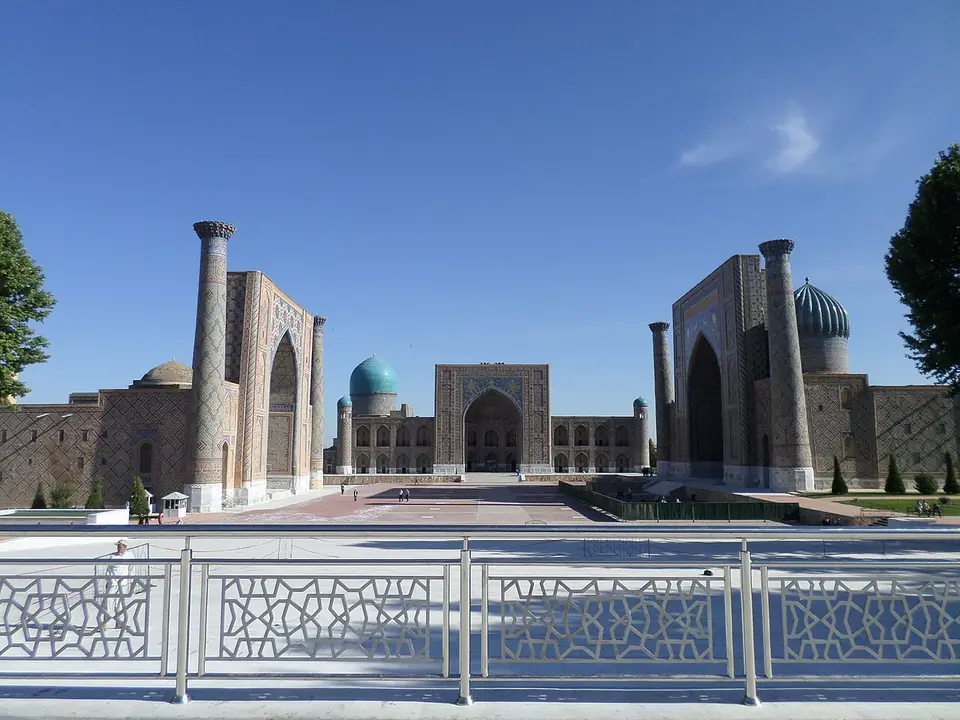
Samarkand and Bukhara were great Silk Road cities, and Samarkand's Registan square is one of Central Asia's most famous sights.
Common mistakes
- Tapping Turkmenistan or Kazakhstan, its two largest neighbours.
- Tapping Kyrgyzstan or Tajikistan, which lie east of Tashkent and interlock with Uzbekistan in the Fergana Valley.
- Choosing a similar striped flag with a crescent and getting the band colours in the wrong order.
Practise with Uzbekistan
- Asia quiz – the central "-stan", south of Kazakhstan and north of Afghanistan.
- Asia flags – blue, white and green with red separators and twelve stars.
- Asia capitals quiz – Tashkent, the largest city in Central Asia.
- Whole World quiz – find the Aral Sea first and you have the northern border.
- Mystery Country – a wide outline with a jagged eastern tail curling into the Fergana Valley.
Nearby countries
 AfghanistanKabul
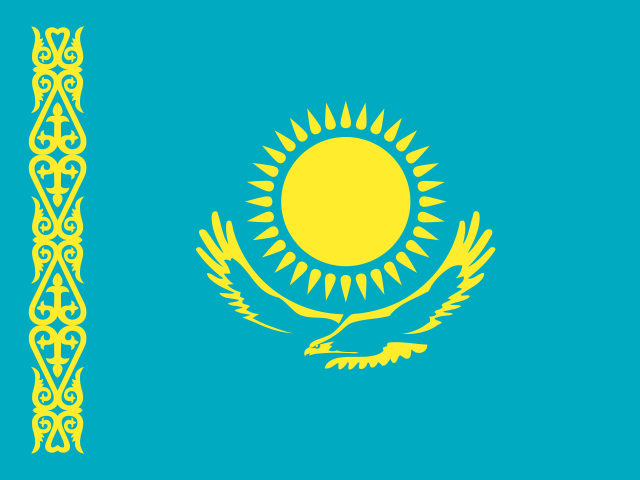 KazakhstanAstana
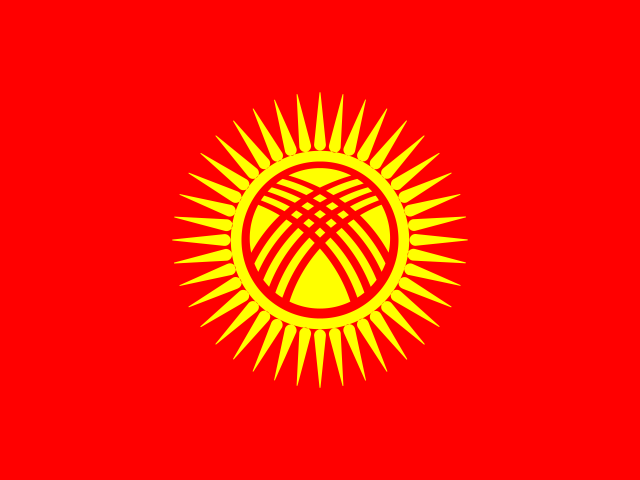 KyrgyzstanBishkek
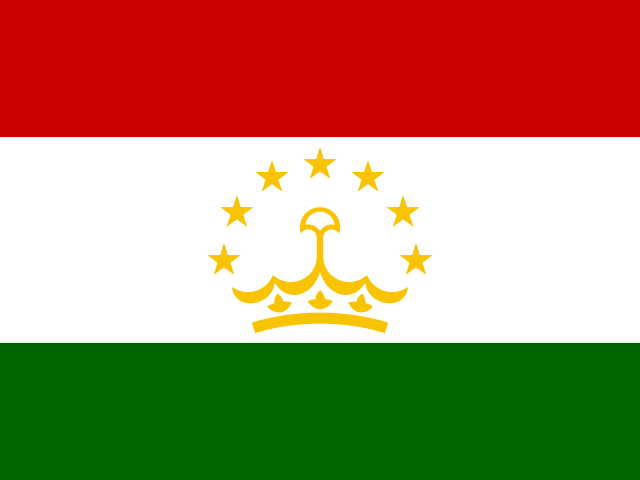 TajikistanDushanbe
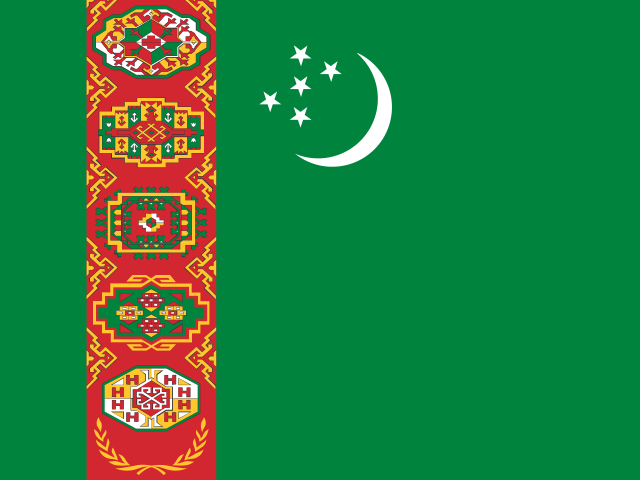 TurkmenistanAshgabat
Quick check: how well do you know Uzbekistan?
3 questions, no sign-up. Tap an answer.
1. Which flag belongs to Uzbekistan?
That's the flag of Uzbekistan.
2. What is the capital of Uzbekistan?
The capital of Uzbekistan is Tashkent.
3. Which of these countries borders Uzbekistan?
Afghanistan, Kazakhstan, Kyrgyzstan, Tajikistan and Turkmenistan border Uzbekistan.
Keep going on the Asia quiz – Uzbekistan is one of 48 countries there.
More ways to practise: find Uzbekistan on the blank map with no borders (hard mode), or play today's Globe and the other daily puzzles.
Frequently asked questions about Uzbekistan
What language is spoken in Uzbekistan?
Uzbek, a Turkic language, is the official language. It is officially written in the Latin alphabet, though Cyrillic is still widely seen. Russian remains common in cities and business, Tajik is spoken in Samarkand and Bukhara, and Karakalpak is co-official in Karakalpakstan.
What currency does Uzbekistan use?
Uzbekistan uses the Uzbek som, or so'm (UZS), introduced in 1994. Since 2017 it has been freely convertible after years of strict currency controls, and it is not pegged to any other currency.
What time zone is Uzbekistan in?
Uzbekistan is on UTC+5 all year, the same as Turkmenistan and Tajikistan. It does not use daylight saving time. That puts it level with Pakistan, half an hour behind India and five hours ahead of London in winter.
Which side of the road do they drive on in Uzbekistan?
Uzbekistan drives on the right, as in all former Soviet republics. Many of its cars are assembled locally at a large factory in Asaka, in the Fergana Valley, so local models dominate the streets.
What is the highest point in Uzbekistan?
The highest point is Khazret Sultan, at about 4,640 metres, in the Gissar Range on the border with Tajikistan. Most of the rest of the country is flat desert and steppe.
Is Uzbekistan doubly landlocked?
Yes. Uzbekistan is one of only two doubly landlocked countries in the world, along with Liechtenstein: it is landlocked, and so are all five of its neighbours. Reaching an ocean means crossing at least two borders.
Quizzes with Uzbekistan
Often confused with
Guides that help with this
- Oceans, seas, rivers and mountainsThe physical map: seas around each continent, the big rivers and ranges.
- Flags that look alike (and how to tell them apart)Chad or Romania? Australia or New Zealand? The flag pairs that cost quiz points.
- The 25 hardest countries to find on a mapPacific islands, Caribbean islands and landlocked Africa – where they are.