Cameroon
Capital: Yaoundé. Cameroon is one of the 54 countries in the Africa quiz.
Quick answers: What is the capital of Cameroon? · Which countries border Cameroon?
Facts about Cameroon
- CapitalYaoundé
- Population29.9 million
- Area475,442 km²
- RegionAfrica
- LanguagesEnglish, French
- CurrencyCentral African CFA franc (XAF)
Cameroon is the 17th most populous of the 54 countries in Africa and the 24th largest by area. Worldwide it ranks 51st by population and 53rd by area.
Where is Cameroon?
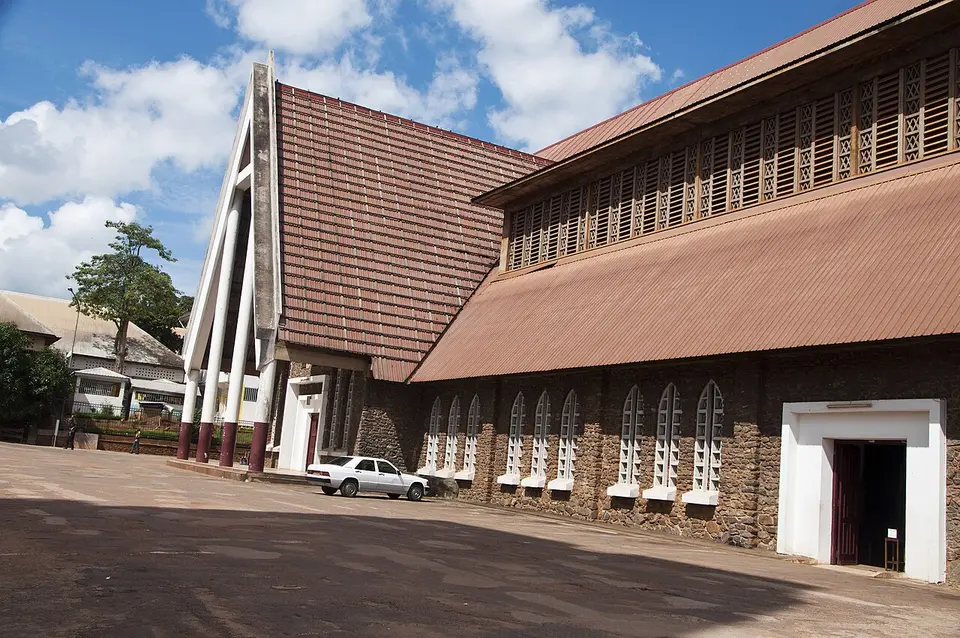
Cameroon sits at the inner corner of the Gulf of Guinea, where the west coast of Africa turns south. It is often described as the hinge between West and Central Africa. Nigeria lies to the west, Chad to the north-east, the Central African Republic to the east, and Congo, Gabon and Equatorial Guinea to the south. The capital is Yaoundé, inland in the south, while the largest city and main port is Douala on the coast.
On a world map, follow the coast of Africa from the western bulge towards the south. The point where the coastline bends sharply is the Bight of Biafra, and Cameroon is the country on the far side of it, just past Nigeria.
How to find Cameroon on the map
- Start from Nigeria. Cameroon is the next country east along the coast and shares a long border with it.
- Find the corner of the Gulf of Guinea. Cameroon occupies the inside of that corner.
- Look for the tall shape. The country is roughly triangular, wide in the south and narrowing to a thin strip that runs north to Lake Chad.
- Don't confuse it with Gabon. Gabon is directly south of Cameroon and sits on the equator; Cameroon is north of it.
Flag
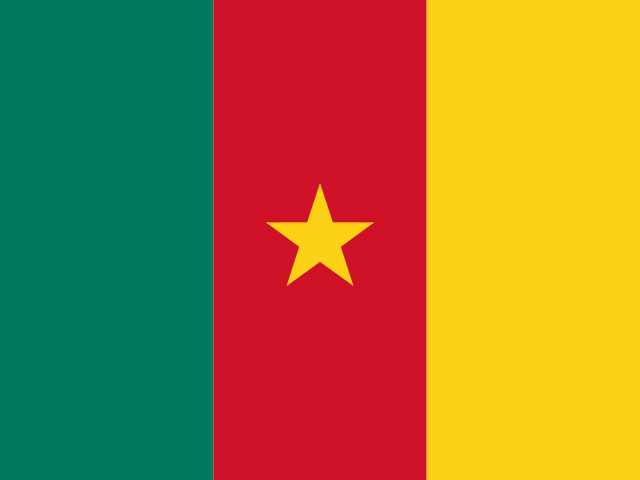
Cameroon's flag is a vertical tricolour of green, red and yellow with a single yellow five-pointed star in the centre of the red band. The colours are the pan-African set shared by Ethiopia, Ghana and Senegal. Green stands for the forests of the south, yellow for the savanna of the north, and red for unity between the two.
In the Flags quiz, the risk is confusion with Senegal, which also has green, yellow and red vertical bands with a star. Senegal's order is green-yellow-red with a green star on yellow; Cameroon's is green-red-yellow with a yellow star on red.
A short history of Cameroon
People have lived in Cameroon's forests for a very long time, including the Baka and other forest peoples. Scholars believe the great Bantu migrations, which spread Bantu languages across half of Africa, began in the grasslands along today's border between Cameroon and Nigeria. In the north, the Kanem-Bornu empire around Lake Chad held sway for centuries, and in the 1800s Fulani warriors launched a jihad that created the emirate of Adamawa. In the western highlands, kingdoms such as Bamum and the Bamiléké chiefdoms built strong local states.
Portuguese sailors reached the coast in the 1470s, and Douala traders later sold slaves and palm oil to Europeans. In 1884 Germany signed treaties with Douala chiefs and created the colony of Kamerun. During the First World War, British and French forces drove the Germans out. The League of Nations then split the colony: France received the larger eastern part, and Britain took two narrow strips along the Nigerian border, which it ran as part of Nigeria.
French Cameroon became independent on 1 January 1960. Its path there was violent: the UPC independence party, led by Ruben Um Nyobè, had fought an armed rebellion that France crushed. In 1961 the people of the British territories voted. The northern strip chose to join Nigeria, while the southern one joined Cameroon, creating a federal republic. The federation was replaced by a single unitary state in 1972, which many English speakers resented.
Cameroon has had only two presidents since independence, Ahmadou Ahidjo and his successor, who has ruled since 1982. Since 2016 a conflict in the English-speaking North-West and South-West regions has displaced many people, while the far north has suffered attacks by Boko Haram.
Cameroon has one of the more varied economies in Central Africa, exporting oil, timber, cocoa, coffee, cotton and bananas, and Douala is a major port for its landlocked neighbours.
Culture and daily life in Cameroon
With hundreds of languages, Cameroon is one of the most linguistically diverse countries on Earth. In cities people mix French and English with Camfranglais, a lively slang, and Pidgin English is widely spoken in the west. The south is mainly Christian, the north mainly Muslim, and traditional beliefs remain important everywhere.
Old kingdoms still play a part in modern life. In Foumban, the Bamum sultan's palace houses a museum, and in around 1900 King Njoya invented a whole new writing system for the Bamum language. Grassland chiefdoms are famous for beaded thrones, carved masks and elephant masks covered in coloured beads.
Cameroon gave the world makossa, a dance music from Douala made famous by Manu Dibango's "Soul Makossa" in 1972, and bikutsi, a fast rhythm from the Beti people around Yaoundé. Football is a passion. Roger Milla danced at the corner flag in 1990, and Samuel Eto'o became one of Africa's greatest strikers.
Five facts worth knowing
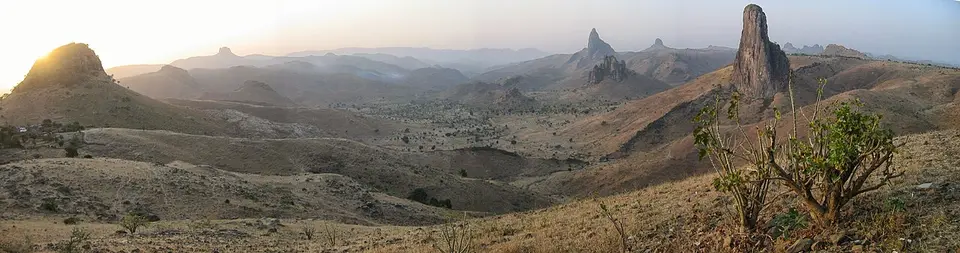
- Cameroon is called "Africa in miniature" because it contains desert in the far north, savanna, mountains, rainforest and coastline all in one country.
- Mount Cameroon is an active volcano and the highest peak in West and Central Africa at just over 4,000 metres, rising almost directly from the sea.
- The country is officially bilingual in French and English, a legacy of its division between French and British control after the First World War.
- The name comes from the Portuguese "Rio dos Camarões", meaning river of prawns, after the shrimp they found in the Wouri estuary.
- Cameroon's national football team, the Indomitable Lions, reached the World Cup quarter-finals in 1990, the first African team to do so.
Culture and traditions in Cameroon
- Saying hello
A handshake with "Bonjour" or "Good morning", as French and English are both official.
- Food and drink
Ndole (bitterleaf stew with peanuts) and poulet DG, chicken with plantains.
- Festivals and traditions
National Day on 20 May, and the Ngondo water festival of the Sawa people in Douala in December.
- Everyday life
Taking time to greet everyone in a room is important, and many people speak several languages.
- Did you know?
Cameroon is often called "Africa in miniature" and has more than 250 local languages.
Common mistakes
- Tapping Nigeria, the larger neighbour to the west.
- Tapping Gabon or Congo, which are further south along the same coast.
- Choosing the Senegal flag in the Flags quiz.
Practise with Cameroon
- Africa quiz – find the corner of the Gulf of Guinea and tap the country just east of Nigeria.
- West Africa quiz – Cameroon appears at the far eastern edge of the region.
- Africa flags – practise separating Cameroon from Senegal and the other pan-African tricolours.
- Africa capitals quiz – Yaoundé, not Douala.
- Mystery Country – a triangle with a long thin handle pointing north towards Lake Chad.
Nearby countries
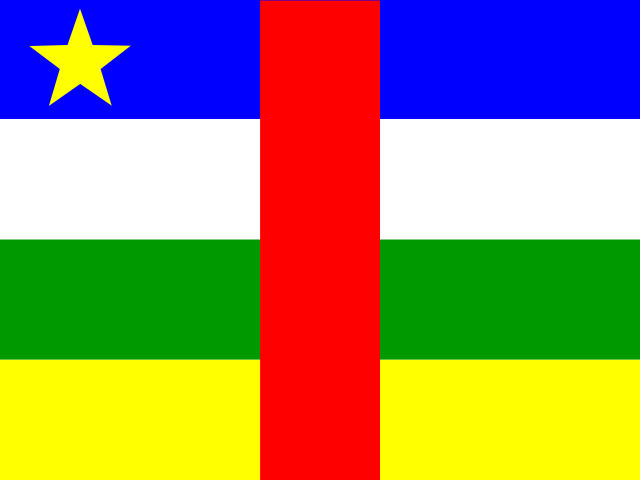 Central African RepublicBangui
 ChadN'Djamena
 CongoBrazzaville
 Equatorial GuineaMalabo
 GabonLibreville
 NigeriaAbuja
Quick check: how well do you know Cameroon?
3 questions, no sign-up. Tap an answer.
1. Which flag belongs to Cameroon?
That's the flag of Cameroon.
2. What is the capital of Cameroon?
The capital of Cameroon is Yaoundé.
3. Which of these countries borders Cameroon?
Central African Republic, Chad, Congo, Equatorial Guinea, Gabon and Nigeria border Cameroon.
Keep going on the Africa quiz – Cameroon is one of 54 countries there.
More ways to practise: find Cameroon on the blank map with no borders (hard mode), or play today's Globe and the other daily puzzles.
Frequently asked questions about Cameroon
What language is spoken in Cameroon?
French and English are both official languages. French is spoken by the majority, while English is used mainly in the two western regions that were once under British rule. Cameroon also has more than 200 local languages, and Cameroonian Pidgin English is widely spoken.
What currency does Cameroon use?
Cameroon uses the Central African CFA franc (XAF), shared with five other countries of the Central African Economic and Monetary Community. It is pegged to the euro at 655.957 francs to one euro.
What time zone is Cameroon in?
Cameroon is on West Africa Time, UTC+1, all year round and does not use daylight saving time. It shares its clock with Nigeria, Chad and Gabon.
Which side of the road do they drive on in Cameroon?
Cameroonians drive on the right. The English-speaking west, once run as part of British Nigeria, drove on the left until it switched in the years after reunification in 1961.
What is the highest point in Cameroon?
The highest point is Mount Cameroon, about 4,040 metres, an active volcano rising from the coast near Buea. The town of Debundscha, at its foot, is one of the wettest places on Earth.
Why is Cameroon called "Africa in miniature"?
Cameroon is called "Africa in miniature" because it contains almost every major African landscape: rainforest in the south, savanna in the centre, semi-desert near Lake Chad, a volcanic mountain and coastline. It also has a great variety of peoples and languages.
Quizzes with Cameroon
Guides that help with this
- Learn all 54 African countries in a weekLearn the coastline in order, region by region.
- Flags that look alike (and how to tell them apart)Chad or Romania? Australia or New Zealand? The flag pairs that cost quiz points.
- The 25 hardest countries to find on a mapPacific islands, Caribbean islands and landlocked Africa – where they are.