Greece
Capital: Athens. Greece is one of the 46 countries in the Europe quiz.
Quick answers: What is the capital of Greece? · Which countries border Greece?
Facts about Greece
- CapitalAthens
- Population10.4 million
- Area131,990 km²
- RegionsEurope, The Balkans
- LanguageGreek
- CurrencyEuro (EUR)
Greece is the 15th most populous of the 46 countries in Europe and the 14th largest by area. Worldwide it ranks 94th by population and 95th by area.
Where is Greece?
Greece is the southern tip of the Balkan peninsula, hanging down into the Mediterranean between Italy and Turkey. The mainland is bordered by Albania, North Macedonia and Bulgaria to the north and by Turkey to the north-east, across the River Evros. The Ionian Sea separates it from Italy's heel in the west; the Aegean Sea lies between it and Turkey in the east. Athens, the capital, is on the Attica peninsula in the south-east of the mainland, with the port of Piraeus beside it.
Greece has thousands of islands, and they are part of the outline. Crete is the big one, lying east–west across the southern edge of the Aegean. The Peloponnese, the large southern lobe joined to the mainland only by the Isthmus of Corinth, looks like a hand with fingers pointing south.
How to find Greece on the map
- Start from Italy. Greece is across the water to the east of the Italian boot, slightly further south.
- Look for the islands. Nowhere else in Europe is so fragmented. A country that looks like it is dissolving into the sea is Greece.
- Use Turkey as the eastern wall. The islands stop just short of the Turkish coast – some are only a few kilometres from it.
- Find the Peloponnese. The hand-shaped southern lobe is the quickest confirmation that you are looking at Greece and not Albania.
Flag
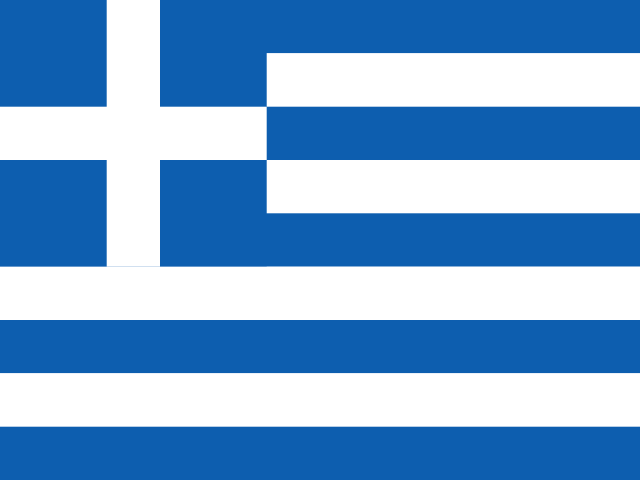
Nine horizontal stripes alternating blue and white – five blue, four white – with a white cross on a blue square in the top hoist corner. The cross stands for the Greek Orthodox Church.
The only flag with a similar feel is Uruguay's, which also has blue and white stripes with a canton, but Uruguay's canton is white with a yellow sun, not blue with a cross.
A short history of Greece
Europe's first great civilisations grew up around the Aegean. The Minoans of Crete built the palace of Knossos about 4,000 years ago, followed by the warrior kingdoms of Mycenae on the mainland. Later, hundreds of independent city-states emerged. Athens developed the world's first democracy from around 508 BC, and Greek cities together held off two Persian invasions, at Marathon in 490 BC and again ten years later. In the 300s BC Alexander the Great of Macedon carried Greek culture as far as Egypt and India.
Rome took control in 146 BC, but Greek remained the language of the eastern Mediterranean. When the Roman Empire split, its eastern half, the Byzantine Empire, ruled from Constantinople for another thousand years, Greek-speaking and Orthodox Christian. After Constantinople fell in 1453, nearly all Greek lands came under Ottoman rule for almost four centuries.
The War of Independence began in 1821 and a small independent Greek state was recognised in 1830, covering only the south of today's country. Modern Greece grew in stages, which explains its sprawling shape: the Ionian Islands joined in 1864, Thessaly in 1881, Crete, Macedonia and Epirus after the Balkan Wars of 1912–13, and the Dodecanese, taken from Italy, in 1947. A disastrous war in Asia Minor ended in 1923 with a population exchange in which over a million Orthodox Christians left Turkey for Greece and hundreds of thousands of Muslims moved the other way.
The 20th century was turbulent: German occupation in the Second World War, a civil war from 1946 to 1949 and a military junta from 1967 to 1974. After the junta fell, a referendum abolished the monarchy and Greece became a parliamentary republic. A severe debt crisis in the 2010s brought years of austerity. Today Greece relies on tourism and on shipping – Greek owners control one of the largest merchant fleets in the world.
Culture and daily life in Greece
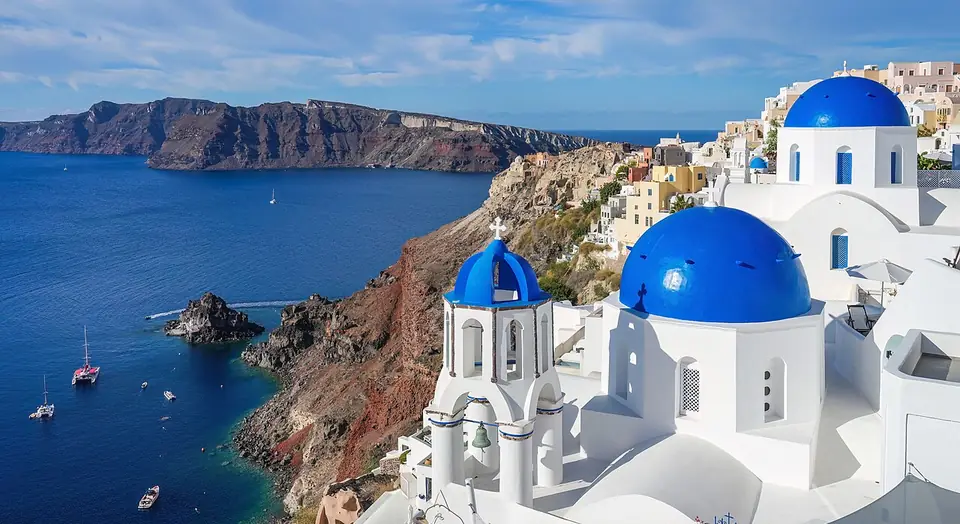
Greek is one of the oldest recorded living languages, written in its own alphabet for nearly 3,000 years, and words like democracy, theatre and philosophy came from it. The Orthodox Church remains central to identity, with whitewashed chapels on almost every hill and island.
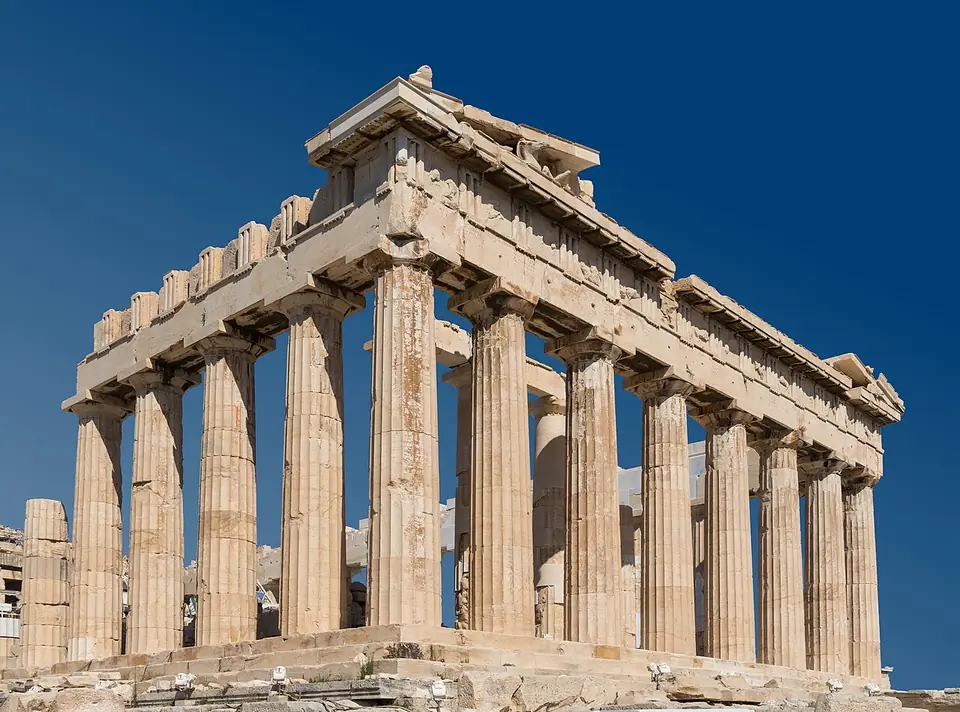
Ancient Greece gave the world Homer's Iliad and Odyssey, the philosophers Socrates, Plato and Aristotle, and the tragedies of Sophocles and Euripides. The Parthenon on the Acropolis and the sanctuary at Delphi still draw millions. Modern writers include Nikos Kazantzakis, author of Zorba the Greek, and the Nobel-winning poets George Seferis and Odysseas Elytis.
Music ranges from rebetiko, the bouzouki-driven songs of the port cities, to the works of composer Mikis Theodorakis. Greece shocked Europe by winning the football European Championship in 2004, and basketball star Giannis Antetokounmpo is a national hero. Life still revolves around the kafeneio, the coffee house, and the old tradition of philoxenia – kindness to strangers. In villages, the evening is still a time to sit outside, play tavli (backgammon) and talk politics.
Five facts worth knowing
- Greece has more than 200 inhabited islands, grouped into clusters such as the Cyclades, Dodecanese, Ionian Islands and Sporades. Crete is by far the largest.
- Mount Olympus, the home of the ancient gods, is the highest peak at 2,917 metres, near the Aegean coast in the north.
- The Corinth Canal cuts the Peloponnese off from the mainland. Opened in 1893, it is about 6 km long and only around 25 metres wide at water level.
- Greece joined the EU in 1981 and adopted the euro in 2001, replacing the drachma.
- Athens hosted the first modern Olympic Games in 1896 and hosted them again in 2004.
Culture and traditions in Greece
- Saying hello
"Yia sou" (hello) with a handshake; friends often kiss on both cheeks.
- Food and drink
Moussaka; souvlaki; Greek salad with feta and olive oil; ouzo as an aperitif.
- Festivals and traditions
Orthodox Easter in spring is the biggest celebration; name days are celebrated throughout the year.
- Everyday life
Dinner is often eaten late, and long coffee breaks, such as iced freddo espresso, are a favourite pastime.
- Did you know?
Many Greeks celebrate their name day, the saint's day matching their name, as much as or more than their birthday.
Common mistakes
- Tapping Albania or North Macedonia – both sit directly above Greece and are also mountainous and irregular.
- Tapping Turkey's western coast, which the Greek islands hug closely in the Aegean.
- Confusing Crete with Cyprus, a separate country further east, off the coast of Turkey.
Practise with Greece
- Europe quiz – the island-strewn country south of the Balkans and east of Italy.
- Balkans quiz – Greece's northern neighbours are small and easily mixed up; this quiz zooms in on them.
- Europe flags – the blue and white stripes with the cross in the corner.
- Europe capitals quiz – Athens.
- Mystery Country – the Peloponnese "hand" and the long line of Crete across the bottom give it away.
Nearby countries
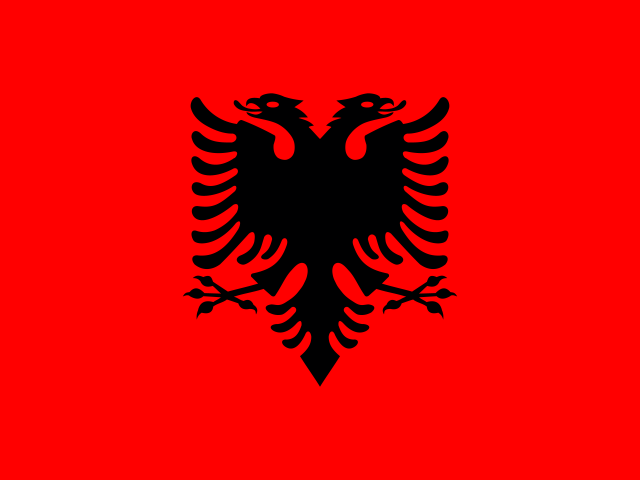 AlbaniaTirana
 BulgariaSofia
 North MacedoniaSkopje
 TurkeyAnkara
Quick check: how well do you know Greece?
3 questions, no sign-up. Tap an answer.
1. Which flag belongs to Greece?
That's the flag of Greece.
2. What is the capital of Greece?
The capital of Greece is Athens.
3. Which of these countries borders Greece?
Albania, Bulgaria, North Macedonia and Turkey border Greece.
Keep going on the Europe quiz – Greece is one of 46 countries there.
More ways to practise: find Greece on the blank map with no borders (hard mode), or play today's Globe and the other daily puzzles.
Frequently asked questions about Greece
What language is spoken in Greece?
Greek is the official language, spoken by almost everyone and written in the Greek alphabet. English is widely spoken, especially in tourist areas. Small minorities speak Turkish in Thrace, along with Pomak and Aromanian.
What currency does Greece use?
Greece uses the euro (EUR), which replaced the drachma in 2002. The drachma was one of the oldest currencies in the world, with a name going back to ancient Greek coins. Greek euro coins feature images such as the Athenian owl.
What time zone is Greece in?
Greece uses Eastern European Time, UTC+2, and changes to UTC+3 for summer time from late March to late October. Greece is one hour ahead of Italy and most of the EU, the same as Bulgaria, Romania and Cyprus.
Which side of the road do they drive on in Greece?
Greeks drive on the right. Island hopping is mostly by ferry, and the Rio–Antirrio Bridge, one of the longest cable-stayed bridges in the world, links the Peloponnese with mainland Greece.
What is the highest point in Greece?
Mount Olympus, in the north of the country, is the highest point, rising to just over 2,900 metres at its peak, Mytikas. In Greek myth it was the home of the twelve Olympian gods.
Why is Greece called Hellas?
Greeks call their country Hellas or Ellada and themselves Hellenes, after the mythical ancestor Hellen. The English name 'Greece' comes from the Latin Graecia, used by the Romans after the Graeci, a group of Greek settlers they encountered in Italy.
Quizzes with Greece
Guides that help with this
- All 46 European capitals, with a memory trick for eachCapitals grouped by region, with hooks for the ones people forget.
- Flags that look alike (and how to tell them apart)Chad or Romania? Australia or New Zealand? The flag pairs that cost quiz points.
- The 25 hardest countries to find on a mapPacific islands, Caribbean islands and landlocked Africa – where they are.