Jordan
Capital: Amman. Jordan is one of the 48 countries in the Asia quiz.
Quick answers: What is the capital of Jordan? · Which countries border Jordan?
Facts about Jordan
- CapitalAmman
- Population11.5 million
- Area89,342 km²
- RegionsAsia, Middle East
- LanguageArabic
- CurrencyJordanian dinar (JOD)
Jordan is the 27th most populous of the 48 countries in Asia and the 31st largest by area. Worldwide it ranks 84th by population and 110th by area.
Where is Jordan?
Jordan is in the Middle East, east of the River Jordan from which it takes its name. Israel and the West Bank lie to the west, Syria to the north, Iraq to the north-east and Saudi Arabia to the east and south. The country is almost landlocked, with just a short stretch of Red Sea coast at Aqaba in the far south. The capital, Amman, is in the north-west, where most of the population lives.
Most of Jordan is desert; the farms and cities sit in the Jordan Valley and the hills around Amman.
How to find Jordan on the map
- Start from Israel. Jordan is the country directly east of Israel, across the river and the Dead Sea.
- Look for the straight lines. Jordan's borders with Saudi Arabia and Iraq are long, ruler-straight desert lines, giving the country an angular eastern edge.
- Find the notch in the Red Sea. The Gulf of Aqaba is the Red Sea's north-eastern arm; Jordan has a few kilometres of coast at its tip.
- Syria is above, Saudi Arabia below. Jordan is the smaller country between the two.
Flag
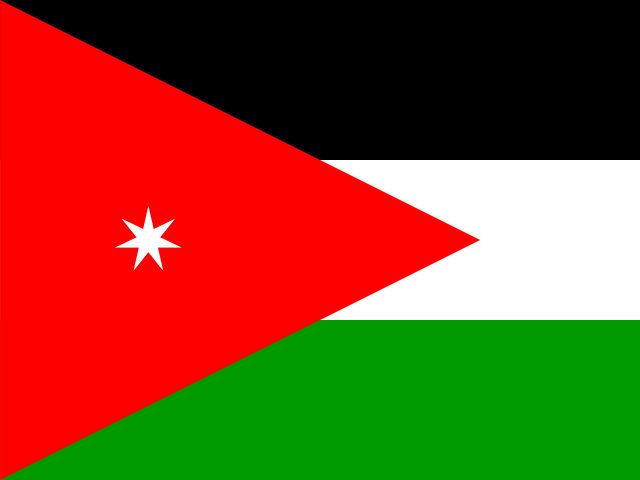
Jordan's flag has three horizontal bands – black, white and green – with a red triangle at the hoist containing a white seven-pointed star. The colours come from the Arab Revolt flag of 1916, and the star's seven points represent the seven verses of the opening chapter of the Quran.
The flag of Palestine is identical except for the star, so look carefully: a white star in the red triangle means Jordan. Western Sahara uses the same bands with a red star and crescent in the centre.
A short history of Jordan
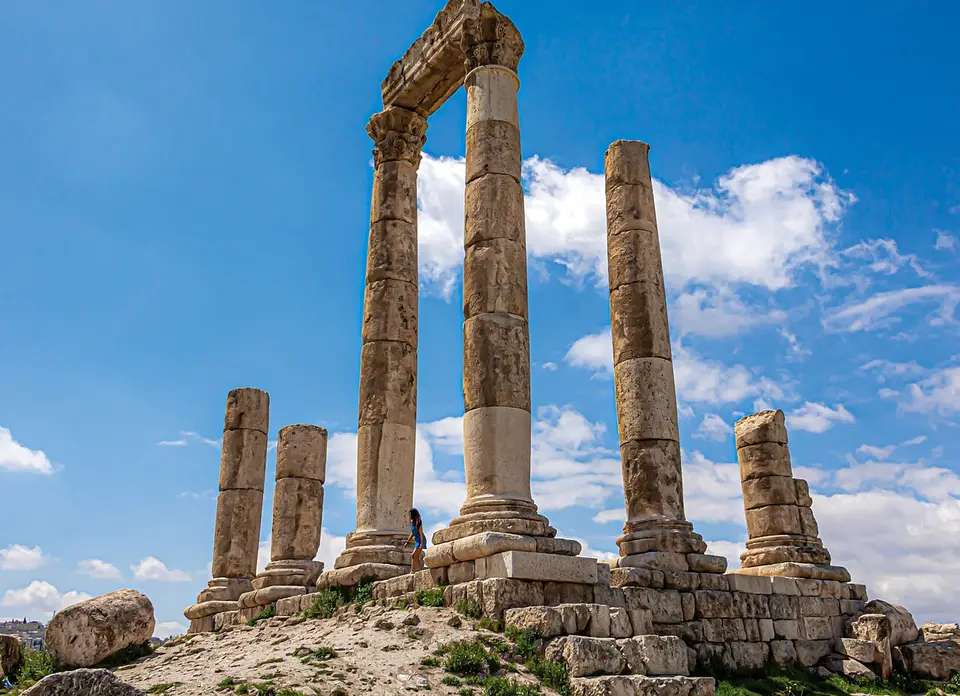
The land east of the Jordan River has been a crossroads for thousands of years. In biblical times it held the small kingdoms of Ammon, Moab and Edom; Amman takes its name from the Ammonites, whose capital stood on the same hills. Later the Romans ruled the area as part of a league of Greek-style cities called the Decapolis. Jerash, north of Amman, keeps colonnaded streets, theatres and temples from that era, and Amman itself was then called Philadelphia.
Under Byzantine rule the region became largely Christian; the floor of a church in Madaba holds a 6th-century mosaic map of the Holy Land. Arab Muslim armies arrived in the 630s, winning the decisive Battle of Yarmouk near today's northern border. Umayyad caliphs built hunting lodges and desert palaces in the eastern steppe, and centuries later Crusaders raised castles at Kerak and Shobak to control the caravan route. From 1516 the area was a quiet province of the Ottoman Empire.
The Arab Revolt of 1916, led by the Hashemite family of Mecca, helped drive the Ottomans out. Britain then created the Emirate of Transjordan in 1921 under Emir Abdullah. The desert borders were drawn by colonial officials, which is why so many of them are straight lines. Full independence came in 1946, and the name was shortened to Jordan in 1949.
Jordan took control of the West Bank, including East Jerusalem, in the 1948 war and lost it to Israel in 1967, and each conflict brought large numbers of Palestinian refugees. In 1970 fighting broke out between the army and Palestinian armed groups, known as Black September. King Hussein, who reigned from 1952 to 1999, gave up Jordan's claim to the West Bank in 1988 and signed a peace treaty with Israel in 1994.
Jordan has few natural resources besides phosphates and potash. It has taken in many refugees from Iraq and Syria, and depends on tourism, services and foreign aid.
Culture and daily life in Jordan
Arabic is the national language, spoken in a Levantine dialect close to those of Syria and Palestine, and English is common in business and universities. Most Jordanians are Sunni Muslims, but one of the world's oldest Christian communities lives here too. The site on the river where many believe Jesus was baptised, Bethany Beyond the Jordan, is listed by UNESCO.
Jordanian identity blends settled town life with Bedouin tradition. Desert hospitality, tribal ties and poetry recited to the one-stringed rababa remain part of national culture, and many families still prepare zarb, meat slow-cooked in a pit under the sand. At weddings, lines of dancers link arms for the stamping dabke.
Crafts include hand-woven rugs, embroidered dresses whose patterns once revealed a woman's home village, Madaba-style mosaics and the coloured sand bottles made by artists in Petra and Wadi Rum. Football is the most popular sport, and the national team's run to the final of the Asian Cup in early 2024 set off celebrations across the country.
Five facts worth knowing
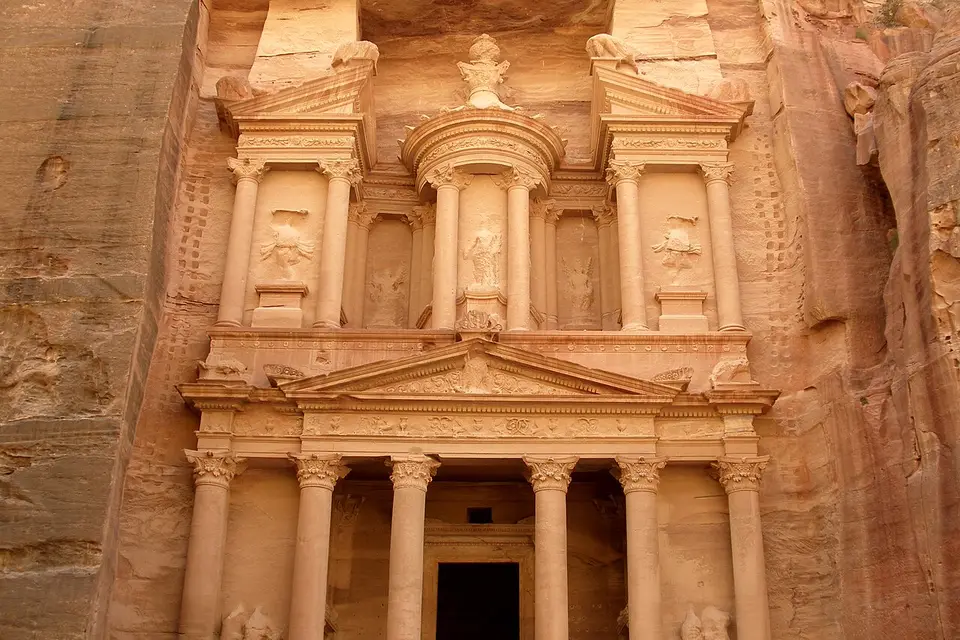
- Petra, the rose-red city carved into sandstone cliffs by the Nabataeans, is Jordan's most famous site and a UNESCO World Heritage site.
- The Dead Sea, on Jordan's western border, is the lowest point on land, with its shore more than 400 metres below sea level.
- Jordan is a Hashemite kingdom – the ruling family claims descent from the Prophet Muhammad, and the country's official name is the Hashemite Kingdom of Jordan.
- Wadi Rum, a desert valley in the south, has stood in for Mars and other planets in many films.
- Aqaba is Jordan's only port, sharing the head of the Gulf of Aqaba with the Israeli city of Eilat.
Culture and traditions in Jordan
- Saying hello
"Marhaba" or "As-salamu alaykum", often with a hand on the heart.
- Food and drink
Mansaf, lamb cooked in fermented yogurt sauce served on rice, the national dish; knafeh, a sweet cheese pastry.
- Festivals and traditions
The Jerash Festival of Culture and Arts in summer; Independence Day on 25 May.
- Everyday life
Guests are offered Arabic coffee; gently shaking the empty cup signals you have had enough. Hospitality is deeply valued.
- Did you know?
Petra, the famous rose-red city, was carved into sandstone cliffs by the Nabataeans over 2,000 years ago.
Common mistakes
- Tapping Israel, which lies on the other side of the Jordan River.
- Tapping Syria or Saudi Arabia, the larger neighbours north and south.
- Choosing the Palestinian flag in the Flags quiz – check for the star.
Practise with Jordan
- Middle East quiz – the zoomed-in map makes the Jordan Valley and the straight desert borders easy to see.
- Asia quiz – find the eastern Mediterranean and go one country inland.
- Asia flags – learn the Arab Revolt family: Jordan, Palestine, Kuwait, the UAE.
- Asia capitals quiz – Amman.
- Mystery Country – an angular shape with a long straight south-eastern edge and a tiny tail reaching the Red Sea.
Nearby countries
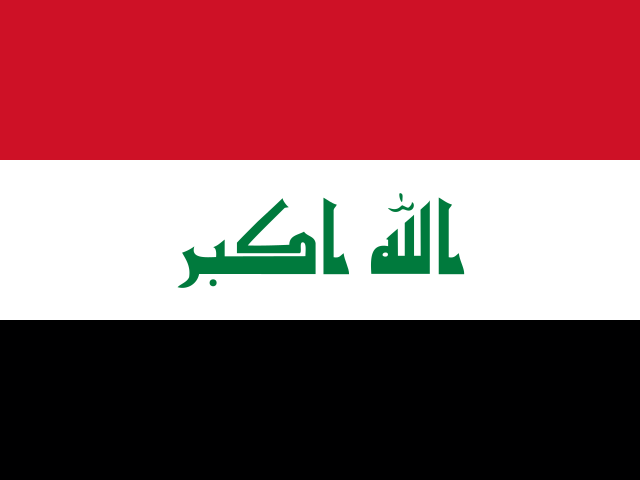 IraqBaghdad
 IsraelJerusalem
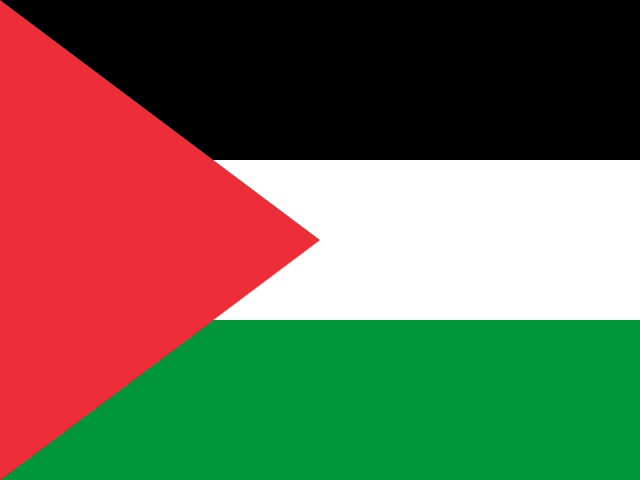 PalestineRamallah
 Saudi ArabiaRiyadh
 SyriaDamascus
Quick check: how well do you know Jordan?
3 questions, no sign-up. Tap an answer.
1. Which flag belongs to Jordan?
That's the flag of Jordan.
2. What is the capital of Jordan?
The capital of Jordan is Amman.
3. Which of these countries borders Jordan?
Iraq, Israel, Palestine, Saudi Arabia and Syria border Jordan.
Keep going on the Asia quiz – Jordan is one of 48 countries there.
More ways to practise: find Jordan on the blank map with no borders (hard mode), or play today's Globe and the other daily puzzles.
Frequently asked questions about Jordan
What language is spoken in Jordan?
Arabic is the official language, spoken in a Levantine dialect similar to that of Palestine and Syria. English is widely used in business, higher education and tourism, and small Circassian, Chechen and Armenian communities keep their own languages.
What currency does Jordan use?
Jordan uses the Jordanian dinar (JOD), divided into 1,000 fils, though prices are often quoted in piastres, worth ten fils. The dinar has been pegged to the US dollar since 1995 and is worth more than one dollar.
What time zone is Jordan in?
Since 2022 Jordan has stayed on UTC+3 all year, having made its former summer time permanent. Before that it used UTC+2 in winter and switched to UTC+3 in summer.
Which side of the road do they drive on in Jordan?
Jordan drives on the right. The Desert Highway and the older King's Highway both run from Amman south towards Aqaba; the King's Highway is a winding scenic route that passes Madaba, Kerak and the road to Petra.
What is the highest point in Jordan?
The highest point is Jabal Umm al-Dami, about 1,854 metres, in the far south near the Saudi border, close to Wadi Rum. On a clear day the Red Sea can be seen from the top.
What is Jordan famous for?
Jordan is famous for Petra, the rose-red Nabataean city carved into rock, for the desert landscapes of Wadi Rum, and for the Dead Sea. It also has well-preserved Roman cities such as Jerash and the baptism site at Bethany beyond the Jordan.
Quizzes with Jordan
Often confused with
Guides that help with this
- Oceans, seas, rivers and mountainsThe physical map: seas around each continent, the big rivers and ranges.
- Flags that look alike (and how to tell them apart)Chad or Romania? Australia or New Zealand? The flag pairs that cost quiz points.
- The 25 hardest countries to find on a mapPacific islands, Caribbean islands and landlocked Africa – where they are.