Lithuania
Capital: Vilnius. Lithuania is one of the 46 countries in the Europe quiz.
Quick answers: What is the capital of Lithuania? · Which countries border Lithuania?
Facts about Lithuania
- CapitalVilnius
- Population2.9 million
- Area65,300 km²
- RegionsEurope, Central & Eastern Europe
- LanguageLithuanian
- CurrencyEuro (EUR)
Lithuania is the 29th most populous of the 46 countries in Europe and the 23rd largest by area. Worldwide it ranks 138th by population and 121st by area.
Where is Lithuania?
Lithuania is the southernmost and largest of the three Baltic states, on the eastern shore of the Baltic Sea. Latvia lies to the north, Belarus to the east and south-east, Poland to the south-west and the Russian exclave of Kaliningrad to the west along the coast. The capital, Vilnius, is in the south-east, close to Belarus and unusually far inland for a Baltic capital.
On a world map, find Poland and look at its north-eastern corner. Above the Kaliningrad exclave, the next country is Lithuania – the first Baltic state you reach coming up from Central Europe.
How to find Lithuania on the map
- Start from Poland. Lithuania is to the north-east, the only Baltic state that borders Poland.
- Find Kaliningrad. The small Russian territory on the coast sits in Lithuania's south-western corner.
- Count the Baltic trio from the bottom. Lithuania, then Latvia, then Estonia going north.
- Don't confuse it with Latvia. Latvia has the Gulf of Riga; Lithuania has a short, almost straight coast with a long sandy spit.
Flag
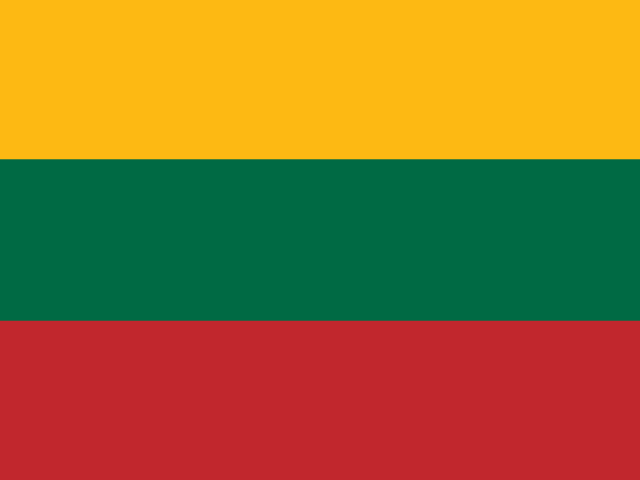
Lithuania's flag is three equal horizontal bands of yellow, green and red, yellow at the top. The yellow stands for the sun and prosperity, the green for forests and hope, and the red for courage and blood shed for the homeland. It was adopted in 1918 and restored in 1988 as the country moved towards independence from the Soviet Union.
The flags it is confused with are Bolivia (red, yellow, green) and Ethiopia (green, yellow, red with an emblem). Yellow on top, red at the bottom and no emblem means Lithuania.
A short history of Lithuania
Baltic tribes lived along the south-eastern Baltic shore for thousands of years, collecting amber and farming forest clearings. The name Lithuania first appears in a written record in 1009. In the 1200s, while crusading orders such as the Teutonic Knights conquered their neighbours, Lithuanian tribes united under Mindaugas, who was crowned king in 1253 – the only crowned king in Lithuanian history.
After his death the rulers took the title Grand Duke and stayed loyal to the old gods. Lithuania was the last pagan state in Europe. Under Gediminas, who made Vilnius the capital, and his successors the Grand Duchy expanded east and south over Slavic lands. In 1386 Grand Duke Jogaila married the Polish queen Jadwiga, became king of Poland and converted Lithuania to Christianity. In 1410 Polish and Lithuanian armies crushed the Teutonic Knights at the Battle of Grunwald.
In 1569 the Union of Lublin joined the two lands into the Polish-Lithuanian Commonwealth, one of Europe's largest states. Polish culture gradually came to dominate the nobility. In 1791 the Commonwealth adopted one of the first written national constitutions in Europe, but by 1795 Russia, Prussia and Austria had divided it between them, and most of Lithuania became part of the Russian Empire. After uprisings in 1831 and 1863, Russia banned Lithuanian books in the Latin alphabet for 40 years. "Book smugglers" carried Lithuanian books printed in Prussia across the border, and they are still national heroes.
Lithuania declared independence on 16 February 1918. Poland seized Vilnius in 1920, so between the wars the capital was Kaunas. The Soviet Union occupied the country in 1940, and during the Nazi occupation that followed almost all of Lithuania's large Jewish community was murdered. Soviet rule returned in 1944, along with mass deportations and a long guerrilla resistance by the "forest brothers".
After independence in 1990 and the bloody events of January 1991, when Soviet troops attacked the Vilnius TV tower, Lithuania joined the EU and NATO in 2004 and adopted the euro in 2015. It is now known for its fast-growing tech and laser industries.
Culture and daily life in Lithuania
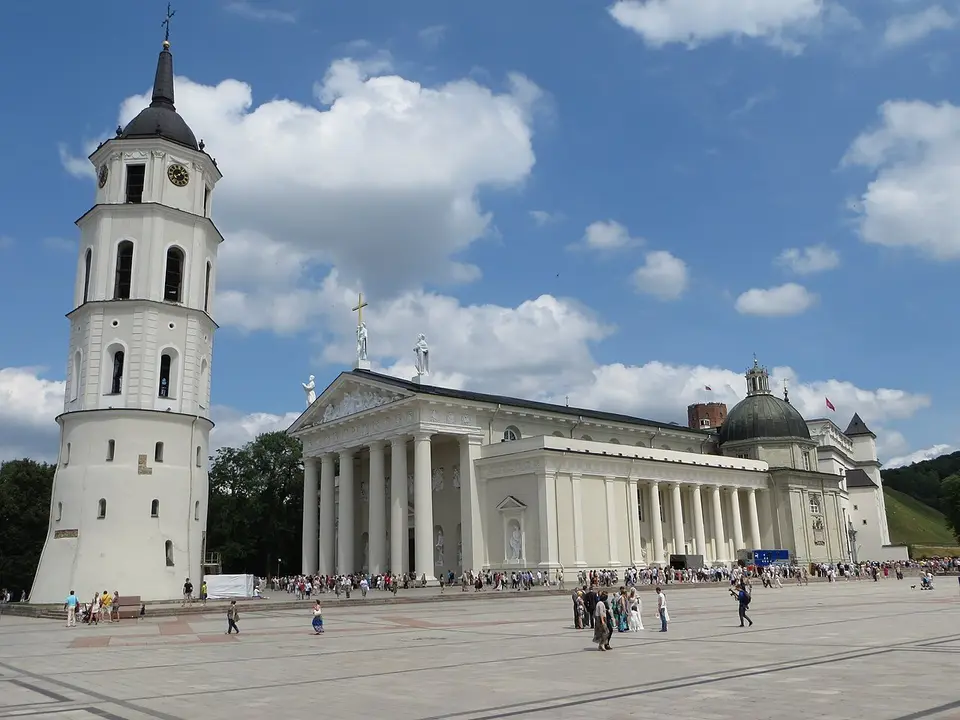
Lithuanian women's surnames traditionally show marital status: the ending -ienė marks a married woman, while -aitė or -ytė marks an unmarried one. Most Lithuanians are Roman Catholic, and the Hill of Crosses near Šiauliai, covered with tens of thousands of crosses left by pilgrims, became a symbol of quiet resistance in Soviet times. Vilnius was also a great centre of Jewish learning, once called the "Jerusalem of the North".
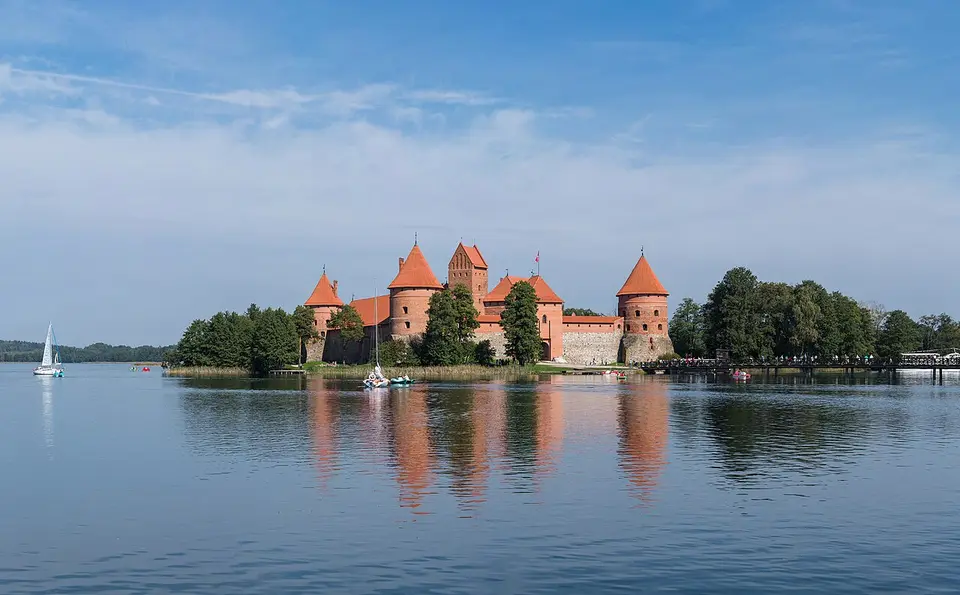
Vilnius has one of the largest baroque old towns in Central Europe, and Trakai Island Castle stands on a lake west of the capital. Folk traditions include sutartinės, an ancient form of many-voiced song listed by UNESCO, and the craft of carving wooden roadside shrines and crosses.
The composer and painter M. K. Čiurlionis is the country's most celebrated artist. Basketball heroes such as Arvydas Sabonis and Šarūnas Marčiulionis are household names, and the national team's games bring towns to a standstill.
Five facts worth knowing
- Lithuania was the first Soviet republic to declare independence, on 11 March 1990, more than a year before the Soviet Union collapsed.
- The medieval Grand Duchy of Lithuania was one of the largest states in Europe, stretching from the Baltic to the Black Sea.
- The Curonian Spit is a 98 km sand-dune peninsula along the coast, shared with Kaliningrad and listed by UNESCO.
- Basketball is the national sport, and Lithuania has won three Olympic bronze medals in it despite a population under three million.
- Lithuanian is considered the most conservative living Indo-European language, keeping features lost in almost every other branch.
Culture and traditions in Lithuania
- Saying hello
"Labas" (hello) with a firm handshake.
- Food and drink
Cepelinai, large potato dumplings filled with meat; šaltibarščiai, a bright pink cold beetroot soup.
- Festivals and traditions
Joninės (Midsummer) on 24 June; Kaziukas Fair in Vilnius in early March.
- Everyday life
Flowers are given in odd numbers. Basketball is followed with great passion.
- Did you know?
Lithuanian is one of the oldest living Indo-European languages, keeping many ancient features similar to Sanskrit.
Common mistakes
- Tapping Latvia or Estonia – the Baltic trio is the classic swap.
- Tapping Belarus, the larger inland neighbour.
- Choosing Bolivia's flag in the Flags quiz.
Practise with Lithuania
- Europe quiz – the bottom Baltic state, touching Poland and Kaliningrad.
- Europe flags – yellow, green, red from the top.
- Europe capitals quiz – Vilnius, inland in the south-east.
- Mystery Country – a rounded outline with a short coast on the left and a long spit along it.
- Mistake Bank – drill the Baltics here if they keep catching you.
Nearby countries
Quick check: how well do you know Lithuania?
3 questions, no sign-up. Tap an answer.
1. Which flag belongs to Lithuania?
That's the flag of Lithuania.
2. What is the capital of Lithuania?
The capital of Lithuania is Vilnius.
3. Which of these countries borders Lithuania?
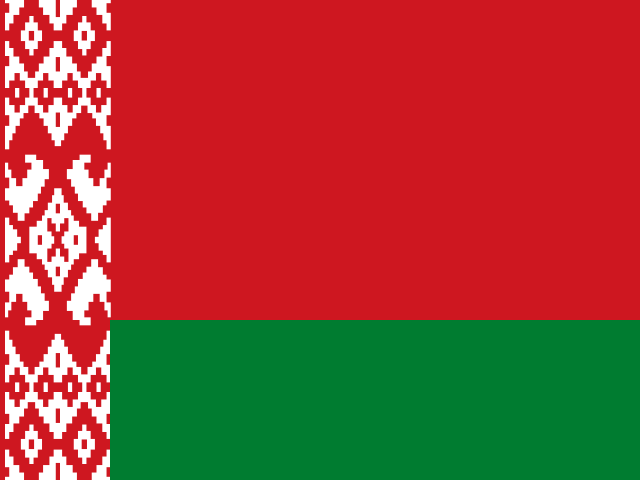
Belarus, Latvia, Poland and Russia border Lithuania.
Keep going on the Europe quiz – Lithuania is one of 46 countries there.
More ways to practise: find Lithuania on the blank map with no borders (hard mode), or play today's Globe and the other daily puzzles.
Frequently asked questions about Lithuania
What language is spoken in Lithuania?
Lithuanian is the official language. It is one of the oldest-sounding Indo-European languages still spoken, keeping many features of ancient grammar. Russian and Polish are spoken by minorities, especially in and around Vilnius, and English is widely learned by younger people.
What currency does Lithuania use?
Lithuania uses the euro (EUR), which it adopted on 1 January 2015, replacing the litas. It was the last of the three Baltic states to join the eurozone. Lithuanian euro coins show the Vytis, a knight on horseback from the national coat of arms.
What time zone is Lithuania in?
Lithuania uses Eastern European Time, UTC+2, in winter and Eastern European Summer Time, UTC+3, in summer, with clocks changing on the last Sundays of March and October.
Which side of the road do they drive on in Lithuania?
Lithuania drives on the right. Dipped headlights must be on at all times, and the main motorway, the A1, links Vilnius with Kaunas and the port of Klaipėda on the Baltic coast.
What is the highest point in Lithuania?
Lithuania is low and gently rolling. Its highest point is Aukštojas Hill, about 294 metres, in the south-east near the Belarusian border, not far from Vilnius.
What is Lithuania famous for?
Lithuania is famous for its passion for basketball, often called the country's second religion; the national team has won EuroBasket three times and Olympic bronze medals. It is also known for the Hill of Crosses near Šiauliai and the castle at Trakai.
Quizzes with Lithuania
Often confused with
Guides that help with this
- All 46 European capitals, with a memory trick for eachCapitals grouped by region, with hooks for the ones people forget.
- Flags that look alike (and how to tell them apart)Chad or Romania? Australia or New Zealand? The flag pairs that cost quiz points.
- The 25 hardest countries to find on a mapPacific islands, Caribbean islands and landlocked Africa – where they are.