Austria
Capital: Vienna. Austria is one of the 46 countries in the Europe quiz.
Quick answers: What is the capital of Austria? · Which countries border Austria?
Facts about Austria
- CapitalVienna
- Population9.2 million
- Area83,871 km²
- RegionsEurope, Central & Eastern Europe
- LanguageGerman
- CurrencyEuro (EUR)
Austria is the 17th most populous of the 46 countries in Europe and the 19th largest by area. Worldwide it ranks 98th by population and 112th by area.
Where is Austria?
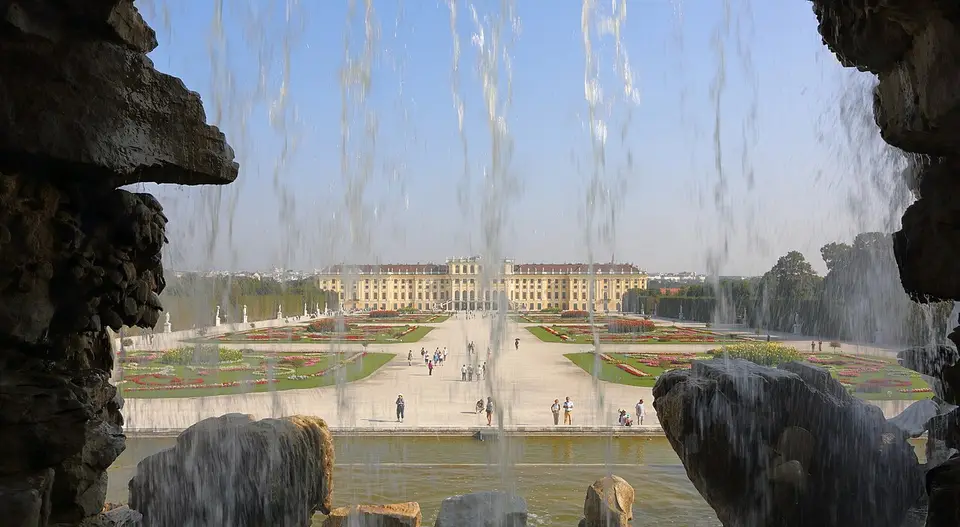
Austria is a landlocked country in Central Europe, stretched east–west along the Alps. It touches eight countries: Germany and Czechia to the north, Slovakia and Hungary to the east, Slovenia and Italy to the south, and Switzerland and Liechtenstein to the west. Vienna, the capital, is in the far east, on the Danube, closer to Bratislava in Slovakia than to any large Austrian city.
On a world map, find Germany and look at its southern edge. The country beneath it, running east towards Hungary, is Austria.
How to find Austria on the map
- Start from Germany. Austria is the country immediately south of Germany's south-eastern corner, south of Munich.
- Look for the shape. Austria is wide in the east and narrows to a thin strip in the west – something like a tadpole swimming towards Switzerland.
- Don't confuse it with Switzerland. Switzerland is the compact country west of Austria that touches France. Austria never touches France.
Flag
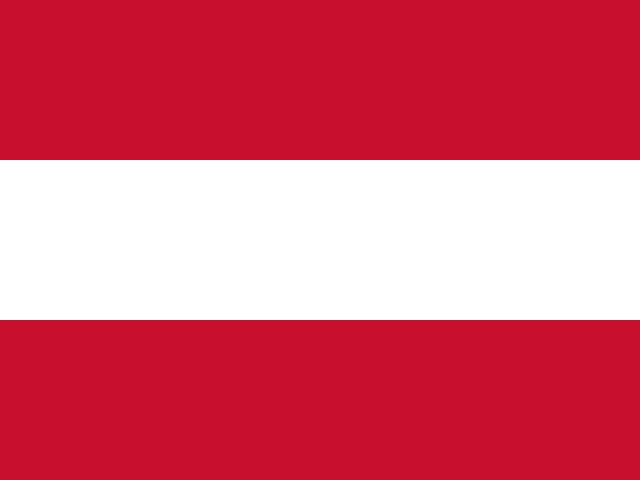
The Austrian flag is three horizontal bands – red, white, red. It is one of the oldest flag designs still in use; legend tells of a duke whose white tunic was stained red with blood except where his belt had been.
The flag most often confused with it is Latvia's, also red-white-red but with a much darker maroon and a noticeably thinner white band. If the red is bright and the three stripes are equal, it's Austria. Lebanon's flag has a similar layout but with a green cedar in the centre.
A short history of Austria
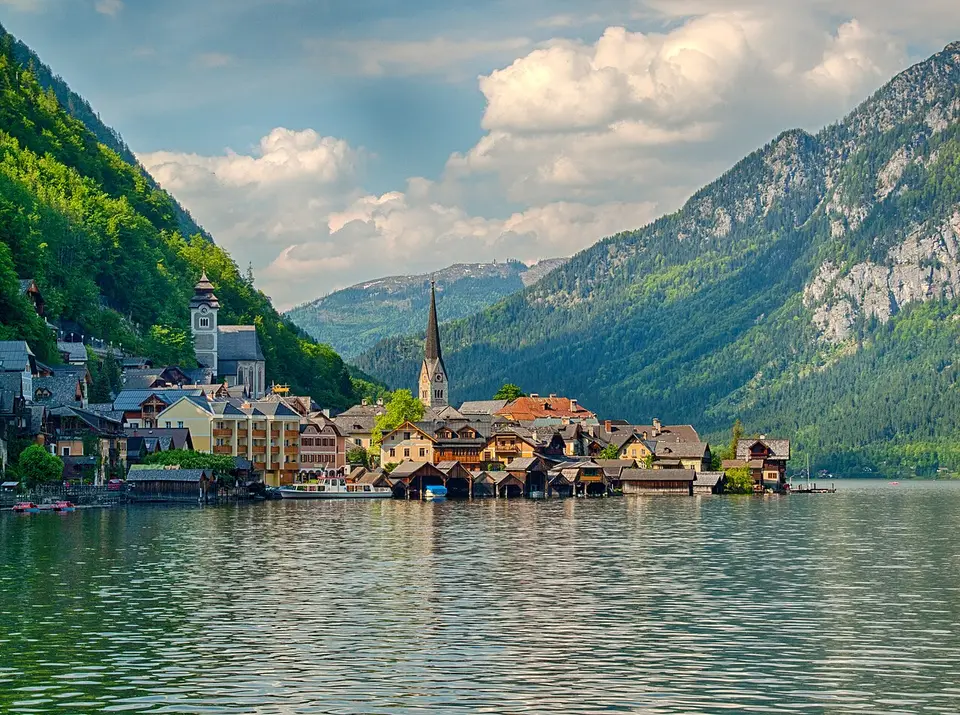
Salt made this region rich long before Austria existed. The village of Hallstatt gave its name to an early Iron Age culture, whose people mined salt deep in the mountains nearly 3,000 years ago. Celts later formed the kingdom of Noricum, and the Romans pushed their frontier up to the Danube, founding camps at Carnuntum and Vindobona, the forerunner of Vienna.
In 976 the Babenberg family was given a march, or border territory, on the Danube to guard the eastern edge of the Holy Roman Empire. The name Ostarrîchi, meaning roughly "eastern realm" and the root of Österreich, first appears in a document from 996. In 1278 Rudolf of Habsburg won control of Austria, beginning more than six centuries of Habsburg rule. Through clever marriages as much as war, the family came to rule lands from Spain to Hungary. Vienna withstood Ottoman sieges in 1529 and 1683, and in the 1700s Empress Maria Theresa modernised the state.
After Napoleon dissolved the Holy Roman Empire in 1806, the Habsburgs ruled the Austrian Empire, which became Austria-Hungary in 1867. The assassination of heir Franz Ferdinand in Sarajevo in 1914 started the First World War. Defeat in 1918 broke the empire apart, leaving a small German-speaking republic, which is why modern Austria is so compact and why South Tyrol, with its German-speaking population, ended up in Italy.
The new republic was poor and divided, and in 1938 Nazi Germany annexed it in the Anschluss. Hitler himself had been born in the Austrian town of Braunau am Inn. After 1945 the Allies occupied the country in four zones, with Vienna also divided, a setting made famous by the film The Third Man.
Modern Austria is one of the richest countries in Europe, with strong industry and huge numbers of tourists. Vienna hosts several United Nations offices and the headquarters of OPEC.
Culture and daily life in Austria
German is the national language, but Austrians use many words of their own, such as Jänner for January and Paradeiser for tomato, and dialects vary from valley to valley. Small Slovene, Croatian and Hungarian minorities live in Carinthia and Burgenland. Most Austrians are Roman Catholic, and baroque abbeys such as Melk tower over the Danube.
Music is the great Austrian export. Mozart was born in Salzburg, and Haydn and Schubert were Austrian too, while Johann Strauss II made the waltz famous with The Blue Danube. The Vienna Philharmonic's New Year's Concert is watched around the world. Around 1900 Vienna was bursting with new ideas: Gustav Klimt painted The Kiss, Egon Schiele created raw, twisting portraits, and Sigmund Freud developed psychoanalysis.
Austrians love the mountains, and skiers such as Hermann Maier and Marcel Hirscher are national heroes. The white Lipizzaner horses of Vienna's Spanish Riding School perform a centuries-old style of riding, and the colourful buildings of Friedensreich Hundertwasser add a playful touch to the cities. In winter, Alpine villages keep alive the Krampus runs, when people in shaggy horned costumes roam the streets in early December.
Five facts worth knowing
- Austria is made of nine federal states (Bundesländer), including Vienna, which is a city and a state at the same time.
- The Alps cover roughly two-thirds of the country. The highest peak is the Grossglockner at 3,798 metres.
- Austria has been officially neutral since 1955, the year it regained full independence after the Second World War. It joined the European Union in 1995 but is not in NATO.
- Vienna was the capital of the Habsburg empire for centuries, which is why the city is so much grander than the country's size would suggest.
- Austria has eight land neighbours, more than any European country except Germany and Russia.
Culture and traditions in Austria
- Saying hello
"Gruss Gott" or "Servus" with a handshake.
- Food and drink
Wiener Schnitzel (breaded veal cutlet) and Sachertorte, a rich chocolate cake.
- Festivals and traditions
The Vienna ball season from January to February, and Christmas markets in December.
- Everyday life
Punctuality matters, most shops close on Sundays, and quiet hours are respected.
- Did you know?
Viennese coffee house culture is listed by UNESCO as intangible cultural heritage.
Common mistakes
- Tapping Switzerland, the other Alpine country, which lies further west.
- Tapping Hungary or Czechia, both of which share a long border with Austria.
- Picking Latvia's flag in the Flags quiz.
- Confusing Austria with Australia in the Capitals quiz.
Practise with Austria
- Europe quiz – the long, tapering country under Germany.
- Austrian States – all nine, from Vorarlberg in the west to Burgenland in the east.
- Europe flags – red-white-red; compare it side by side with Latvia.
- Europe capitals quiz – Vienna, on the Danube.
- Mystery Country – the tadpole outline with the fat eastern end and thin western tail.
Nearby countries
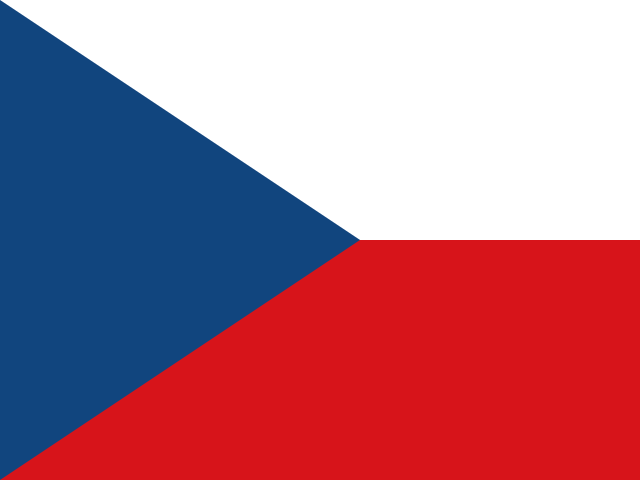 CzechiaPrague
 GermanyBerlin
 HungaryBudapest
 ItalyRome
 LiechtensteinVaduz
 SlovakiaBratislava
 SloveniaLjubljana
 SwitzerlandBern
Quick check: how well do you know Austria?
3 questions, no sign-up. Tap an answer.
1. Which flag belongs to Austria?
That's the flag of Austria.
2. What is the capital of Austria?
The capital of Austria is Vienna.
3. Which of these countries borders Austria?
Czechia, Germany, Hungary, Italy, Liechtenstein, Slovakia, Slovenia and Switzerland border Austria.
Keep going on the Europe quiz – Austria is one of 46 countries there.
More ways to practise: find Austria on the blank map with no borders (hard mode), or play today's Globe and the other daily puzzles.
Frequently asked questions about Austria
What language is spoken in Austria?
German is the official language, spoken in an Austrian variety with its own vocabulary and accents. Several minority languages are recognised regionally, including Slovene in Carinthia and Croatian and Hungarian in Burgenland, and Austrian Sign Language is officially recognised.
What currency does Austria use?
Austria uses the euro (EUR). It joined the euro in 1999, and euro notes and coins replaced the Austrian schilling in 2002. Austrian euro coins show national motifs, such as Mozart on the 1-euro coin.
What time zone is Austria in?
Austria uses Central European Time, UTC+1, and switches to UTC+2 for daylight saving time from late March to late October. It shares its clock with Germany, Switzerland, Italy and the rest of central Europe.
Which side of the road do they drive on in Austria?
Austrians drive on the right. Until the 1930s, parts of Austria drove on the left, and the whole country only switched after it was annexed by Germany in 1938.
What is the highest point in Austria?
The highest point is the Grossglockner, about 3,798 metres, in the Hohe Tauern range of the Alps. The Grossglockner High Alpine Road, opened in 1935, climbs to over 2,500 metres and is one of the most famous mountain roads in Europe.
Why is Austria called Österreich?
The German name Österreich means "eastern realm". It comes from Ostarrîchi, first recorded in a document of 996, when the area was the eastern frontier march of the Holy Roman Empire. The English name Austria comes from the Latinised form of the same word.
Quizzes with Austria
Often confused with
Guides that help with this
- All 46 European capitals, with a memory trick for eachCapitals grouped by region, with hooks for the ones people forget.
- Flags that look alike (and how to tell them apart)Chad or Romania? Australia or New Zealand? The flag pairs that cost quiz points.
- The 25 hardest countries to find on a mapPacific islands, Caribbean islands and landlocked Africa – where they are.