Countries That Changed Their Names (and Why)
On this page
Old atlases, old textbooks and old quiz answers are full of countries that no longer go by those names. Some changed at independence, some after a revolution, and some simply asked the rest of the world to stop using a foreign spelling. This guide goes through the renamings you are most likely to meet, when they happened and why – so when a name in a quiz doesn't match the one you learned at school, you'll know what happened.
Recent changes – the ones that catch people out
These are the newest, so they are the ones most likely to trip you up.
- Eswatini – formerly Swaziland. King Mswati III announced the change in April 2018, at celebrations marking 50 years of independence and his own 50th birthday. "Eswatini" means "land of the Swazis" in siSwati; the king pointed out that "Swaziland" was half English and often got confused with Switzerland.
- North Macedonia – formerly the Republic of Macedonia. The new name came into force in February 2019 under the Prespa Agreement with Greece, which has its own region called Macedonia and had blocked the country's path into NATO and the EU over the name. See North Macedonia vs Bulgaria for its flag.
- Czechia – the short English name entered in UN databases in 2016. The full name is still the Czech Republic; Czechia is to it what France is to the French Republic. In Czech the short form, Česko, has been official since 1993.
- Türkiye – the UN registered Türkiye in place of Turkey on 1 June 2022 after a letter from the Turkish foreign minister. It is the country's own spelling of the name it has always had. On this site the country still appears as Turkey, the name most English speakers type.
- Cabo Verde – formerly Cape Verde in English. In October 2013 the government told the UN it wanted the Portuguese name used in every language.
Hook: the modern trend is countries asking to be called by their own name, in their own language.
Asia
- Myanmar – formerly Burma. The military government changed the English name in June 1989, and Rangoon became Yangon at the same time. "Myanma" had been the formal Burmese name since independence, while "Burma" comes from the everyday spoken form, "Bama". Because the change was made by an unelected regime, some governments – including the United States – still use Burma.
- Sri Lanka – formerly Ceylon. The name was dropped in 1972 when the country became a republic. "Lanka" is the island's ancient name, and "Sri" is an honorific meaning roughly "resplendent". Ceylon tea kept the old name.
- Thailand – formerly Siam. The government of Plaek Phibunsongkhram changed the name in 1939, the country went back to Siam in 1945 after the Second World War, and it became Thailand again in 1949. "Thai" is often translated as "free", though linguists also connect it with a word for "people".
- Iran – formerly Persia in the West. Iranians had long called their country Iran; from March 1935 the government asked foreign countries to use that name in official dealings. "Persia" came from Pars (Fars), one province in the south-west.
- Bangladesh – East Pakistan until independence in 1971. The name means "land of the Bengalis".
- Timor-Leste – often called East Timor in English, but Timor-Leste has been its official name in all languages since independence in 2002. Timor means "east" in Malay and leste means "east" in Portuguese, so the name literally says "east east".
Africa
Most African renamings came at independence, replacing a colonial label with a local or historical name.
- Ghana – formerly the Gold Coast, until independence in 1957. It was named after the medieval Ghana Empire, which was actually several hundred kilometres to the north-west, in today's Mauritania and Mali.
- Mali – formerly French Sudan. It took its name in 1960 from the medieval Mali Empire, the empire of Mansa Musa.
- Zambia and Malawi – formerly Northern Rhodesia and Nyasaland, both renamed at independence in 1964. Zambia is named after the Zambezi River; Lake Nyasa, which gave Nyasaland its name, is called Lake Malawi inside Malawi.
- Tanzania – formed in 1964 when Tanganyika and Zanzibar united. The name blends the two: Tan + Zan + -ia.
- Botswana and Lesotho – formerly Bechuanaland and Basutoland, both renamed at independence in 1966. In both cases the colonial name was a distorted version of the people's own name (Tswana, Sotho).
- DR Congo – called Zaire from 1971 to 1997 under Mobutu Sese Seko, then renamed the Democratic Republic of the Congo when Laurent-Désiré Kabila took power. Not to be confused with its neighbour, the Republic of the Congo – see Congo vs DR Congo.
- Benin – formerly Dahomey, renamed in November 1975. "Dahomey" was the name of one kingdom, linked to the Fon people, so the government chose a neutral name: the Bight of Benin, the bay on its coast. Confusingly, the bay was named after the old Kingdom of Benin – which was in what is now Nigeria.
- Zimbabwe – formerly Rhodesia (named after the colonialist Cecil Rhodes). It took its name at independence in 1980 from the stone ruins of Great Zimbabwe, which also gave the country the bird on its flag.
- Burkina Faso – formerly Upper Volta, after the upper course of the Volta River. Thomas Sankara renamed it in August 1984. Burkina is Mooré for "upright" or "honest" and Faso is Dyula for "fatherland", so the name is usually translated as "land of the upright (or incorruptible) people".
Americas and the Pacific
- Belize – formerly British Honduras. Renamed in 1973, eight years before independence in 1981, taking the name of its main river and largest town.
- Kiribati – formerly the Gilbert Islands, independent since 1979. "Kiribati" is the local spelling of "Gilberts": in Gilbertese "ti" is pronounced "s", so it is said "KIR-i-bas".
- Tuvalu – formerly the Ellice Islands. It split from the Gilberts as a separate colony in 1975 and became independent in 1978. Tuvalu means "eight standing together", for its eight originally inhabited islands.
- Vanuatu – formerly the New Hebrides, run jointly by Britain and France, renamed at independence in 1980. Vanua means "land" or "home" and tu means "to stand" – a land that stands on its own.
Names that didn't change (but people think did)
- Holland – never the name of the country. Holland is two of the twelve provinces of the Netherlands (North and South Holland). In January 2020 the government simply stopped using "Holland" in its own promotion and asked everyone to say the Netherlands.
- Ivory Coast – since 1985 the government has asked for Côte d'Ivoire to be used in every language, and that's what the UN uses. English speakers still widely say Ivory Coast, which is also the name used on this site. Both mean the same country.
- Yugoslavia, the Soviet Union, Czechoslovakia – these weren't renamed; they broke up into several new countries. That is a different kind of change, which you can explore in the Cold War Europe and Former Soviet Union quizzes.
How to remember them
- Learn the old name as a clue, not an answer. Knowing "Upper Volta = Burkina Faso" or "Dahomey = Benin" makes old books, films and news footage make sense.
- Group them by wave. Late 1950s–60s: African independence. 1970s–80s: Pacific islands and the last colonies. 2010s–2020s: countries asking for their own spelling.
- Link the name to its origin. Ghana and Mali took the names of old empires, Zimbabwe of old ruins, Zambia and Belize of rivers. A reason is easier to remember than a date.
Practise it
- Africa 1914 – find the colonies on the map, then compare with today's Africa quiz.
- Europe 1914 and Cold War Europe for the countries that came and went.
- Whole World – every country by its current name.
Tip: play a history map and the modern map of the same region back to back. Seeing Northern Rhodesia and Zambia in the same place a minute apart does more than reading the list twice.
FAQ
What was Thailand called before?
Siam. The name changed to Thailand in 1939, went back to Siam in 1945, and has been Thailand since 1949.
Why did Swaziland change its name to Eswatini?
King Mswati III renamed the country in 2018 to mark 50 years of independence and drop a half-English colonial name. Eswatini means "land of the Swazis" in siSwati.
Is it Burma or Myanmar?
Both refer to the same country. The military government changed the official English name to Myanmar in 1989; most international organisations use Myanmar, while some governments, including the US, still say Burma.
Did Turkey change its name?
Not in Turkish – the country has always been Türkiye. In 2022 it asked the UN and other organisations to use that spelling in English and other languages too.
Sources
More guides
 The 25 Hardest Countries to Find on a Map
25 countries that are hard to find on a world map – Pacific and Caribbean islands, small African states – and exactly where each one is.
 15 Pairs of Countries People Constantly Mix Up
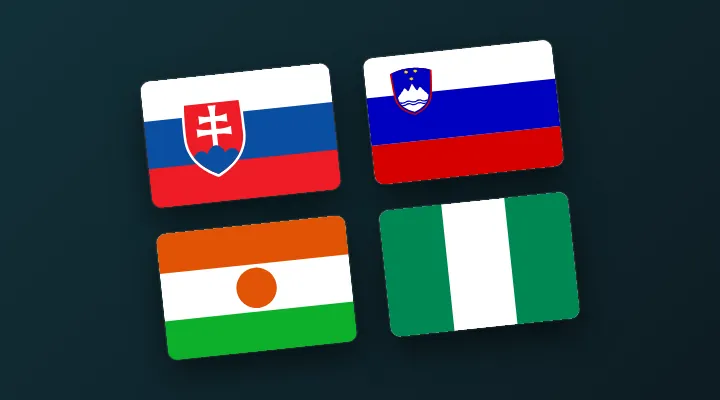
Slovakia vs Slovenia, Niger vs Nigeria, Dominica vs the Dominican Republic – 15 pairs people mix up, with a clear way to tell each apart.
 All 48 Asian Capitals – With a Memory Trick for Each One
All 48 Asian capitals grouped by region, with a memory trick for the ones that never stick.